

Advancing food security: 10 questions on how Food Lion helps local communities where they need it most
The people behind a decade of Ahold Delhaize
September 16, 2026 – Ahold Delhaize was born 10 years ago this summer, when Dutch retailer Ahold N.V. merged with Belgian Delhaize Group, crossing borders to create a strong, customer-focused retailer that today spans nine countries and 17 great local brands. As we celebrate this milestone, we'll be asking colleagues across the company to share their perspective on 10 topics they're closest to.
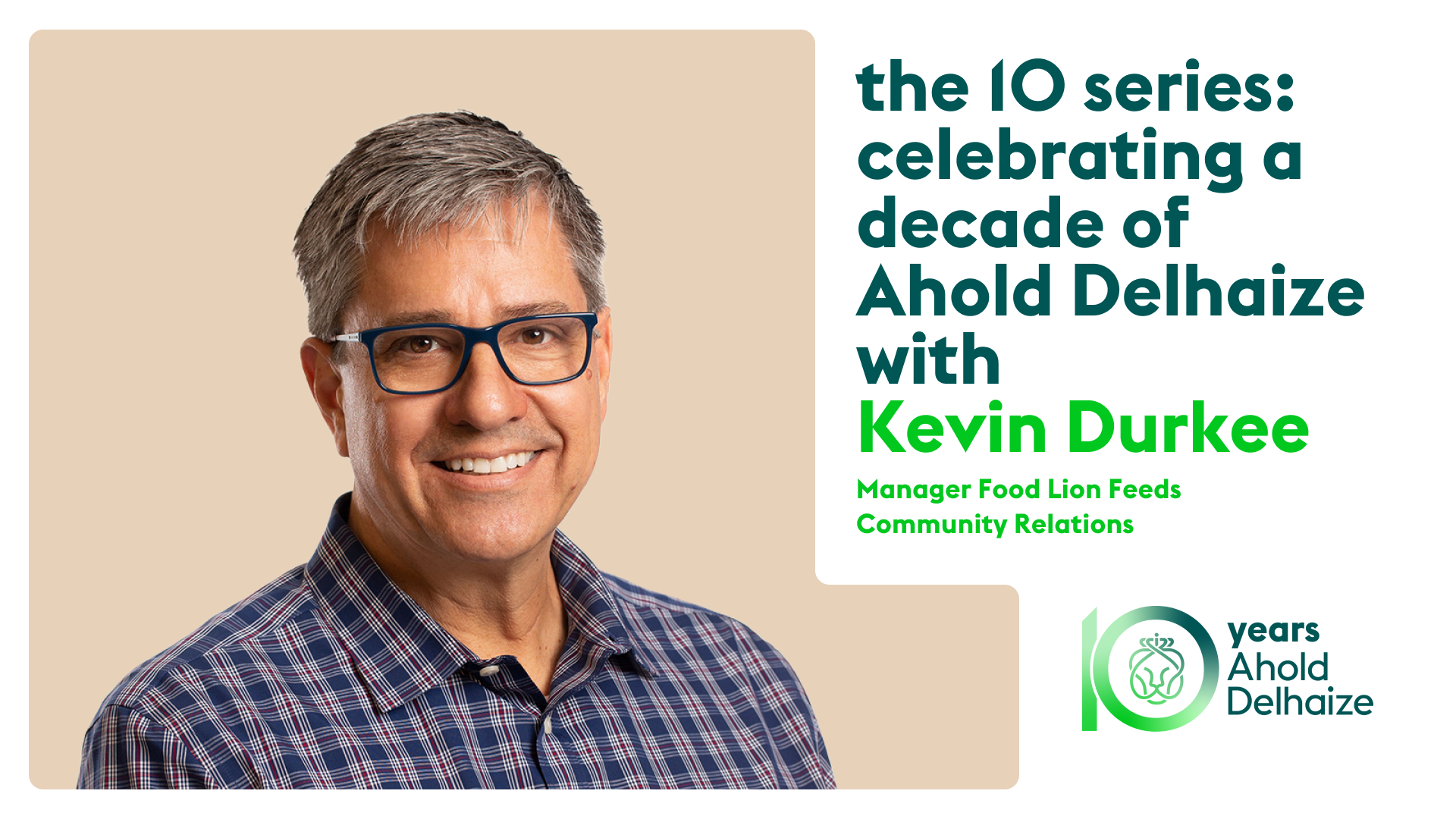
As Manager of Food Lion Feeds, Kevin Durkee helps lead the Food Lion brand’s hunger-relief efforts across the Southeast and Mid-Atlantic United States. We ask him about the evolution of their Food Lion Feeds program, the growing challenges facing customers and communities, and the partnerships that are helping the brand work toward its goal of donating three billion meals by 2032.
1. If you look back on the past 10 years, how has being part of the combined company strengthened your ability to serve customers and communities?
“I've been with Food Lion for more than 20 years and was with Hannaford for 16 years before that, so I've seen firsthand the commitment of the brands to their local communities. I’ve also seen the amazing impact that we can have. As a part of the ADUSA family of brands, I am inspired by the passion of each brand and the change that they are able to create. At Food Lion, we have the opportunity to see what other brands are doing and leverage great ideas to maximize the impact that we have. The ability to borrow a great idea means we are able to move faster to find meaningful solutions to the challenges that exist within the communities that we each are a part of.
“It’s fun to hear what other folks are doing, and ‘steal’ ideas that are working for them to strengthen our own programs. For example, we got the idea to sell reusable bags to benefit hunger relief from another brand. Ultimately this cooperation helps us serve our communities more effectively and make a greater impact.”
2. Can you tell me a little bit about the Food Lion Feeds program and your role in it?
“Food Lion Feeds was launched in 2014 after we asked customers what community issue they felt was most important to them and most relevant for a grocery retailer to address. The answer was overwhelmingly clear: food insecurity. Streamlining our philanthropic efforts with a focus on reducing hunger and helping people access food just made sense. It enables us to engage associates and rally them around a cause that is important to everyone. We believe that no one should have to choose between dinner and rent, or gas and groceries.
“As manager of Food Lion Feeds, I help lead the strategy behind these efforts. That includes helping shape what the program looks like and how we go out into the community, supporting our meal donation goals, tracking and reporting our impact, and helping tell the stories behind the work. A big part of my role is making sure we're continually evolving our approach to meet the changing needs of our neighbors.”
3. Have you seen the impact of a challenging economic environment over the past several years on the needs of people in your communities?
“Absolutely. We recently did a survey with our food bank partners on the most challenging aspects of their work, and they told us that while they see that need is increasing, the resources and donations to support that need are on the decline.
“Rising costs are putting pressure on households across our communities. When families are paying more for rent, utilities, transportation and other necessities, there is less money available for groceries. At the same time, we’re seeing changes in public assistance programs, such as SNAP benefits, and foundations and nonprofits are raising less money. This means there are fewer resources to go around for feeding agencies, food banks and other partners, which makes our role in the fight against hunger even more important.”
4. This takes us back to your comment that "no one should have to choose between dinner and rent, or gas and groceries." How does that philosophy guide the daily operations and strategy at Food Lion Feeds?
“That belief has been part of our mission statement since the beginning of Food Lion Feeds. People with limited resources have to make impossible choices: should I use my paycheck to pay the rent, buy gas or feed my family? Unfortunately, food is often the item that gets pushed to the end of the list when budgets become stretched."
“That reality is always in the forefront of our minds – we feel like people shouldn’t have to make those decisions, and we’re working hard to make sure our neighbors have reliable access to food. It drives everything we do.”
5. Food Lion Feeds has already provided over 1.5 billion meals or meal equivalents since 2014. What’s the biggest shift in how you’ve approached food insecurity during that time?
“Over the years, we’ve learned that food donations are essential, but they are only one part of addressing hunger, so we started focusing on how to set people up for success in life. We expanded our work to support nutritional education and workforce development programs that help people build long-term stability and success.
“However, over the last couple of years, economic pressures have forced us to shift back and focus on access to food. It’s important for us to remain flexible and responsive.’’
"The key is meeting people where they are, understanding what's happening in our communities and adapting our approach to fulfill the most pressing needs.”
6. Food Lion has long been recognized for its food rescue work, aiming to keep edible food entirely out of landfills and get it to neighbors in need. What are some of the ways that you have achieved this – and what are some of the biggest hurdles you’ve faced?
“Food rescue is a collaborative effort – our community relations team can’t do it alone. We partner closely with Retail Operations to ensure there are standard processes and practices, and training aids in place. We work with our feeding partners to make sure they can pick up items at our stores regularly. And we work with our sustainability team on programs to keep as much surplus product out of landfills as possible.
“One of the biggest challenges is maintaining food safety and product quality throughout the process, especially when it comes to produce and other perishable items. In recent years, we've expanded donations of frozen foods and started freezing milk and other dairy products to ensure these nutritious items can reach families in need. We are collaborating to make sure our partners have the transportation, refrigeration and storage capabilities needed to collect and distribute food quickly and safely. Our focus is not only on donating food, but on making sure the full chain works well. ”
7. The “Holidays Without Hunger” campaign and your register round-up initiatives have seen historic success. Why do you think they’ve been so successful? How do you cultivate that deep sense of trust and generosity between Food Lion and your everyday customers?
“Through our Holidays without Hunger program, customers buy boxes filled with food which are then distributed by our food rescue partners to clients in the neighborhood. It takes a lot of people to execute – from the category teams that make sure we have the right items and get them packed into boxes all the way to the logistics, supply chain and Feeding America teams that make sure those products get where they need to go.
“The success of the program comes from engaging everybody in it. Our store teams build amazing displays to encourage customers to participate. We cultivate trust with customers through transparency – we tell customers their donations will stay in their communities to help their neighbors, and we stay true to that. We’ve worked to put healthy and nutritious food in the boxes and put a picture of the contents on the packaging, so customers know what’s inside. And then we communicate about the impact their donations are having, with a focus on tangible examples that show how the money is doing good."
“I think we've been successful in building trust over time, and our customers have been incredibly generous, both through Holidays without Hunger and our register round-up project.”
8. Through the annual Feedys Awards, Food Lion Feeds celebrates local hunger-relief heroes. Why is it so important for a major retailer to shine a spotlight on these grassroots advocates and volunteers?
“As I mentioned before, fighting hunger is a collaborative effort that requires the dedication of vendor partners, feeding partners, food banks, associates, customers and volunteers. The Feedys Awards give us an opportunity to show that this is a group effort and recognize the people who go above and beyond to do great work in their communities. Their stories inspire others to join us in these efforts.
“One recent example of a hero who deserved to be highlighted is a student leader at North Carolina State University who manages a campus food pantry while pursuing her degree. She has a huge passion around feeding people and is helping fellow students and faculty members access food while also inspiring others to get involved. Being able to celebrate her and people like her is really special – it helps elevate awareness and encourages even more community engagement.”
9. Initiatives like the Collegiate Hunger Challenge focus heavily on mobilizing college students. Why do you believe empowering the next generation of student leaders is key to solving campus food insecurity?
“I don’t think people really understand how widespread food insecurity is on and around college campuses. Raising awareness is an important first step, but empowering students to be part of the solution is what creates lasting impact.
“We've seen purpose-driven, passionate, innovative students take on these hunger-relief challenges and do some really cool work. Their ability to use social media and engage fellow students is inspiring to see. Programs like the Collegiate Hunger Challenge give students opportunities to further develop their leadership skills while engaging their communities around an issue that matters. In many ways, they are helping build the next generation of hunger-relief advocates and community leaders.”
10. Food Lion Feeds has set an ambitious goal to donate three billion meals by 2032. What is the next major milestone or innovation your team is focusing on to keep the momentum going toward that target?
“Our focus is on staying in tune with the needs of our communities and evolving our strategy to make sure we’re meeting those needs. Right now, that means continuing to prioritize access to food while also helping our hunger-relief partners build their capacity and capabilities to serve a broader client base sustainably over the long term.
“We're constantly evaluating and improving our programs and building stronger partnerships with colleges and other organizations. Our associates are passionate about serving their communities, and we want to continue to provide them with opportunities to do that.
“As we work towards our three-billion meal goal, the biggest challenge is balancing our ability to serve the needs that exist today while making sure our feeding partners are able to sustainably meet community needs in the long term. By strengthening the organizations on the front lines of hunger relief today while helping them build for the future, we can continue making meaningful progress.”
This article is part of a 10-part series celebrating 10 years of Ahold Delhaize. For a decade, Ahold Delhaize brands have been trusted partners in millions of customers’ daily moments, operating at the heart of local communities. We’ve built a strong foundation in those 10 years – but this is only the beginning. In this series, we look back at where we came from and forward to the future, through the eyes of the people who are making it all happen.