
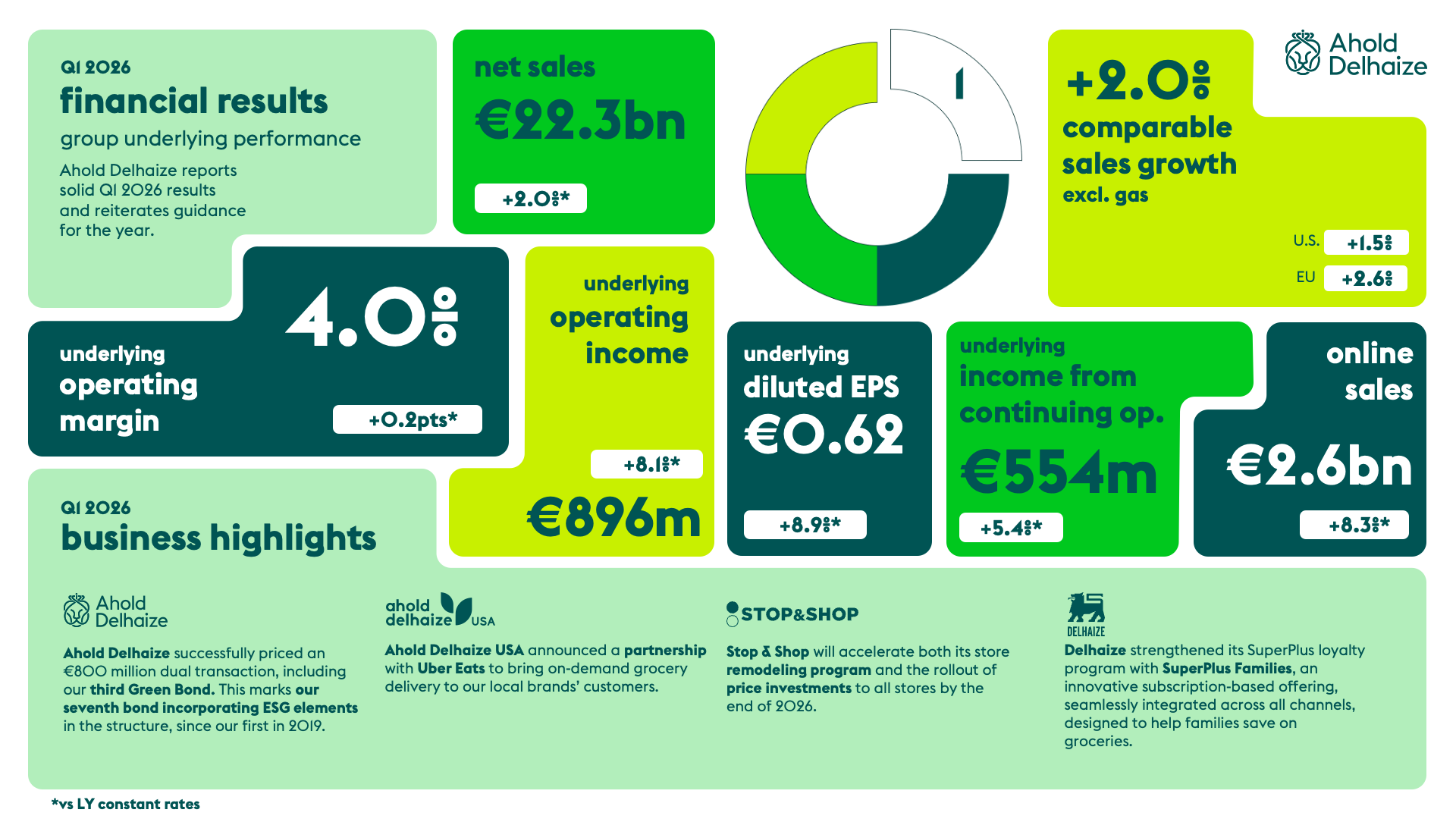
Ahold Delhaize reports solid Q1 2026 results and reiterates guidance for the year
- Through our family of great local brands, we understand what matters most to customers. Customer value remains at the heart of everything we do. Balanced investments – in our customer value propositions, strengthening our portfolio and expanding our footprint – have enabled us to create the resilience we need to adapt and thrive amid the evolving challenges of the retail landscape.
- Q1 net sales were €22.3 billion, up 2.0% at constant exchange rates and down 4.3% at actual exchange rates.
- Q1 comparable sales excluding gasoline increased 1.5% in the U.S. They were positively impacted by 0.4 percentage points due to weather and calendar shifts, and negatively impacted by 1.9 percentage points from pharmacy pricing related to the Inflation Reduction Act, deflation in egg prices and lower Supplementary Nutrition Assistance Program (SNAP) benefits from program changes.
- Q1 comparable sales excluding gasoline increased 2.6% in Europe. The cessation of tobacco sales in Belgium and calendar shifts led to a net negative impact of 0.1 percentage points.
- Our brands' customers appreciate the convenience, assortments and personalization offered by our omnichannel shopping experiences, including the addition of new AI-enabled services. Ahold Delhaize's online sales increased 8.3% in Q1 at constant exchange rates and 2.9% at actual exchange rates. This was driven by strong growth in the U.S. of 14.3% at constant exchange rates.
- Q1 underlying operating margin was 4.0%, an increase of 0.2 percentage points at constant exchange rates. Strong performance in the U.S. and an increase in insurance results at the Ahold Delhaize Group more than offset the effect of the governmental decree and intervention on grocery industry pricing in Serbia. Q1 diluted underlying earnings per share (EPS) was €0.62, an increase of 8.9% compared to the prior year at constant exchange rates.
- Q1 IFRS operating income was €895 million and IFRS-diluted EPS was €0.62.
- Q1 free cash flow was €(330) million, driven by net working capital due to the calendar and seasonal phasing between the quarters and year over year.
- The Company reiterates its 2026 outlook (53 weeks): underlying operating margin of around 4%; mid- to high-single-digit diluted underlying EPS growth at constant exchange rates; free cash flow of at least €2.3 billion; and gross cash capital expenditures of around €2.7 billion.
Zaandam, the Netherlands, May 6, 2026 – Ahold Delhaize, an international food retail group and a leader in both supermarkets and e-commerce, reports first quarter results today.
Summary of key financial data
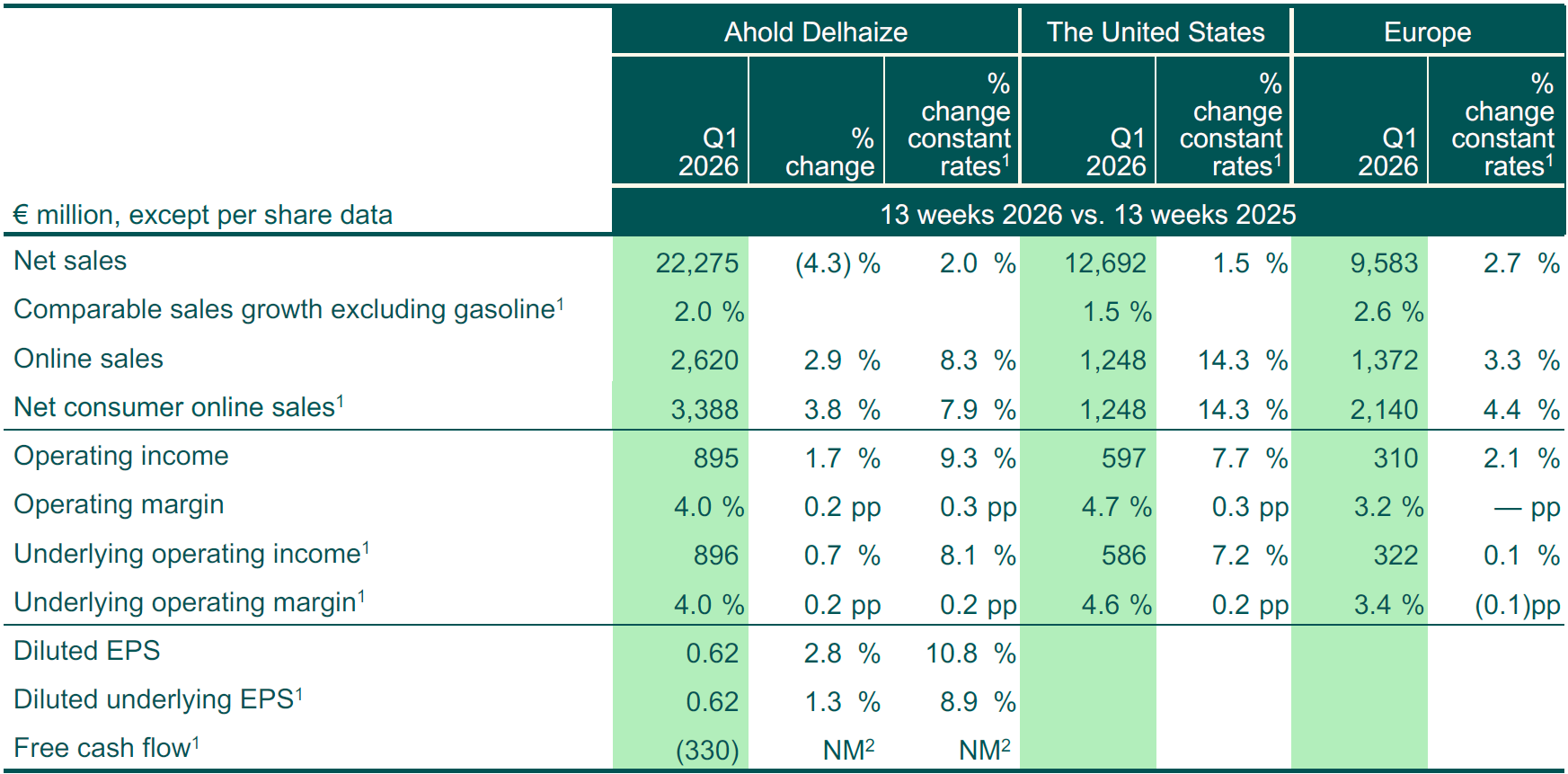
1. Comparable sales growth excluding gasoline, net consumer online sales, underlying operating income and related margin, diluted underlying EPS, free cash flow, and percentage change at constant rates are alternative performance measures and a reconciliation between percentage change and percentage change at constant rates, see Note 12 in the full Interim Report.
2. Not meaningful, as free cash flow is negative in Q1 2026, resulting in a negative percentage change.
Comments from Frans Muller, President and CEO of Ahold Delhaize
“Our solid first quarter results are a testament to the strong foundation we have established with our Growing Together strategy. We have a clear focus on what matters most to customers, associates and all our stakeholders – creating value every day. Balanced investments – in our customer value propositions, strengthening our portfolio and expanding our footprint – have enabled us to create the resilience we need to adapt and thrive amid the evolving challenges of the retail landscape. We do this with thoughtful choices that improve every customer visit through options for personalized value, healthier assortments and smart use of technology.
“Disruptions from geopolitical volatility and tensions, including the recent armed conflict in the Middle East, are a reality our business has managed through before. We draw on previous experience and on the measures we have put in place over the past few years to limit the short-term impacts. For example, following our learnings from the Ukraine war, we have strengthened our energy policies by moving to longer-term contracts and increasing our use of renewable energy sources. And more extensive use of our ‘should-cost’ models gives us the insights to ensure cost increases are proportional and justifiable.
“At the same time, we remain sharply focused on our own strategic levers, to help our brands keep prices as low as possible. Our own-brand products continue to outpace the rest of the store in terms of net sales and volume growth. Through enhanced joint sourcing initiatives in both regions, our brands are driving scale and innovation to offer customers high-quality products for every wallet. We are capturing value through our focused investments in AI. Our approach is two-fold: drive customer engagement and accelerate enterprise efficiency. This is centered on four domains that can make the biggest impact: agentic shopping, marketing, sourcing and merchandising, and store operations. With more than 100 use cases already active in these areas, we are seeing exciting progress and are confident that our continued innovation will deliver even greater benefits for our customers and business.
“Focusing on our Q1 performance, net sales and comparable sales excluding gasoline increased 2.0% at constant exchange rates (net sales decreased 4.3% at actual exchange rates). Thanks to the strong operational execution by our teams of associates during the quarter, we delivered a healthy underlying operating margin of 4.0%. As a result, diluted underlying EPS was up 8.9% at constant exchange rates. On an IFRS basis, we delivered operating income of €895 million and diluted EPS of €0.62.
“In the U.S., net sales and comparable sales excluding gasoline both increased 1.5% at constant exchange rates (net sales decreased 9.0% at actual exchange rates). Top-line performance reflected a mix of factors, with a positive benefit of 0.4 percentage points from winter storms and calendar shifts. Additional influences included a sharp deflation in egg prices relative to the prior year and the impact on pharmacy pricing from the Inflation Reduction Act. At the same time, eligibility changes to the SNAP program reduced the benefits available to our lower-income customers. Together, these additional factors had a negative impact of 1.9 percentage points on comparable sales excluding gasoline.
“As shoppers make deliberate decisions to navigate a challenging consumer environment, our customer value propositions stand out for their healthy, fresh and convenient assortments at attractive prices. To keep groceries affordable, our U.S. brands are enhancing our own-brand assortments, starting the second round of price investments, and optimizing personalized offerings. For example, Stop & Shop lowered everyday prices on chicken at all its stores in New York, New Jersey and Connecticut. Hannaford introduced refreshed own-brand packaging that allows customers to easily find quality and value-focused products across the assortment. And The GIANT Company successfully launched its ‘Simply Low’ campaign, highlighting its improved price position. Despite ongoing pressures in the market, our U.S. brands maintained food volumes and market positions. Even more encouraging, Stop & Shop continues to gain traction, with volumes trending positively, supported by record-high online penetration and a pronounced increase in own-brand volume. With results exceeding our expectations, we are excited to share that we will accelerate both our store remodeling program and the rollout of price investments to all stores by the end of 2026.
“Our performance in Europe exemplifies how our Growing Together strategy provides the necessary tools for our brands to succeed in all types of market conditions. Net sales increased 2.7% at constant and actual exchange rates, while comparable sales excluding gasoline increased 2.6%. Our brands' strong customer relevance is enabling us to strengthen our positions in our brands' markets and drive volume growth. Delhaize completed the acquisition of Delfood, adding over 300 stores in the convenience space, and opened seven new stores under its successful affiliate model. In Serbia, our teams are executing recovery plans now that the government decree limiting grocery prices, which ended in February, is no longer in effect. In addition, we are assessing the impact from a new law on unfair trade practices (UTP), which was recently adopted in April. Having brought together our two brands in Romania, Mega Image and Profi, the teams are successfully capturing synergies. Customers continue to enjoy the familiar stores they trust, while our teams collaborate seamlessly behind the scenes to deliver better value and efficiency.
“Our brands' omnichannel offerings are resonating well with existing customers and winning new customers into our ecosystem. In the U.S., online sales grew 14.3% at constant exchange rates (2.6% at actual exchange rates), marking the eighth consecutive quarter of double-digit growth. Over 90% of our brands' customers have access to online shopping and over 90% of our online sales are fulfilled through same-day delivery options. And we are excited by our recent partnership with Uber Eats, which demonstrates that we are a sought-after partner. Thanks to our great relationships, our network allows our brands to further expand the accessibility and convenience of online services to new and existing customers. At bol, AI and social commerce are redefining how customers search, compare and buy. Bol is expanding its suite of AI-powered tools – including the soon-to-launch ‘Shopper Agent’ – ensuring customers have the support they need throughout their shopping journey.
“Across our channels, we continue to leverage our health strategy as a key differentiator that is connecting well with our brands' customers. In 2025, more than half of our own-brand sales already came from healthy products. As of this year, we will expand our ambition to healthy sales across the full store, reinforcing our commitment to offer customers healthy and affordable products. We make healthy eating easy by offering healthier options and in-store guidance. We leverage our loyalty programs to make it a habit. And our instore dietitians support customers in truly making health a lifestyle.
“Given the solid start to the year, we reconfirm our guidance for 2026. While risks have increased since the beginning of the year, we are confident in our plan. As we move into the summer period, we have a strong investment and activation plan to drive relative performance in volumes and market share in the current environment. The strength of our local teams sets us apart. They are closest to the customer and make decisions every day that truly count. Around them, our support functions keep improving and simplifying operations, helping our brands perform at their best. Together, this gives our business model a lasting edge and gives us confidence in executing our Growing Together strategy for sustainable long-term value creation."
Q1 Financial highlights
Group highlights
Ahold Delhaize net sales were €22.3 billion, an increase of 2.0% at constant exchange rates and down 4.3% at actual exchange rates. Our net sales growth was driven by comparable sales growth excluding gasoline of 2.0%. The Company's Q1 comparable sales excluding gasoline were positively impacted by 0.3 percentage points due to weather and calendar shifts. Pharmacy pricing related to the Inflation Reduction Act, egg price deflation, and lower SNAP benefits from program changes in the U.S. had a negative impact of 1.1 percentage points. In addition, the cessation of tobacco sales at supermarkets in Belgium had a negative impact of 0.1 percentage points.
In Q1, Ahold Delhaize's online sales increased 8.3% at constant exchange rates. This was driven by growth of 14.3% in the U.S.
Ahold Delhaize underlying operating margin was 4.0%, an increase of 0.2 percentage points at constant exchange rates. Strong performance in the U.S. and an increase in insurance results at the Ahold Delhaize Group more than offset the effect of the governmental decree and intervention on grocery industry pricing in Serbia.
In Q1, Ahold Delhaize IFRS operating income was €895 million, representing an IFRS operating margin of 4.0%.
Diluted EPS was €0.62 and diluted underlying EPS was €0.62, up 8.9% at constant exchange rates compared to last year's results.
Free cash flow was €(330) million, driven by net working capital due to the calendar and seasonal phasing between the quarters and year over year.
In the quarter, Ahold Delhaize purchased 6.3 million of its own shares for €224 million.
U.S. highlights
U.S. net sales were €12.7 billion, an increase of 1.5% at constant exchange rates and down 9.0% at actual exchange rates. Comparable sales excluding gasoline in the U.S. increased 1.5%, driven by continued growth in online. Pharmacy prices related to the Inflation Reduction Act, egg deflation and lower SNAP benefits from program changes had a negative impact of 1.9 percentage points. Weather and calendar shifts had a positive impact of 0.4 percentage points.
In Q1, online sales increased 14.3% at constant exchange rates, with strong growth across all brands, led by Food Lion.
Underlying operating margin in the U.S. was 4.6%, up 0.2 percentage points. Higher sales leverage and a favorable mix from winter storms; the positive effect from cost deflation in eggs; and a favorable mix in pharmacy more than offset price investments and additional costs related to winter storms.
Q1 IFRS operating income was €597 million, representing an IFRS operating margin of 4.7%.
Europe highlights
European net sales were €9.6 billion, an increase of 2.7% at constant exchange rates and 2.7% at actual exchange rates. Comparable sales excluding gasoline increased 2.6%. The cessation of tobacco sales at supermarkets in Belgium and calendar shifts had a net negative impact of 0.1 percentage points.
In Q1, online sales increased 3.3%, driven by Albert Heijn and Delhaize Belgium. Albert Heijn's online performance was negatively impacted by heavy snowfall disrupting delivery capabilities. Performance at bol was impacted by the cycling of a strong prior year and increased consumer pressures contributing to down trading within bol's assortment.
Underlying operating margin in Europe was 3.4%, down 0.1 percentage points. The effect of the governmental decree and intervention on grocery industry pricing in Serbia was partially offset by the realization of synergies and lower turnover tax rate (IMCA) in Romania.
Europe's Q1 IFRS operating income was €310 million, representing an IFRS operating margin of 3.2%.
Outlook
Following the first quarter performance, we reiterate our 2026 outlook, which we announced when we published our Q4 2025 results. Underlying operating margin is expected to be around 4%. Diluted underlying EPS is expected to grow at a mid- to high-single-digit rate at constant exchange rates. Free cash flow is expected to be at least €2.3 billion. Gross cash capital expenditures are planned at around €2.7 billion.
The following are changes in the business that will impact comparable performance for 2026 and that have been incorporated into our Outlook:
- The Inflation Reduction Act will impact U.S. pharmacy sales by more than our original guidance. We now expect this will have an approximate $450 million negative impact on reported and comparable store sales in the U.S. There is no material impact on underlying operating income.
- The acquisition of Delfood closed on February 2, 2026, and is expected to add over €200 million in net sales to our Europe segment.
- 2026 will have a 53rd week, which is expected to have a positive impact of 1.5-2% on net sales and a positive impact of around 2-3% on underlying income from continuing operations. This does not significantly impact underlying operating margin.

1. Excludes M&A.
2. 2026 is a 53-week calendar year.
3. Management remains committed to the Company's share buyback and dividend programs while continuously assessing macroeconomic, geopolitical and legislative factors as part of its decision-making process. In addition, the programs may be adjusted in response to corporate activities, including significant mergers and acquisitions.
4. Our dividend policy is to target a dividend payout ratio range of 40-50%.
downloads

This communication contains information that qualifies as inside information within the meaning of Article 7(1) of the EU Market Abuse Regulation.
This communication includes forward-looking statements. All statements other than statements of historical facts may be forward-looking statements. Forward-looking statements can be identified by certain words, such as “anticipate,” “intend,” “plan,” “goal,” “seek,” “believe,” “project,” “estimate,” “expect,” “strategy,” “future,” “likely,” “may,” “should,” “will” and similar references to future periods.
Forward-looking statements are subject to risks, uncertainties and other factors that are difficult to predict and that may cause the actual results of Koninklijke Ahold Delhaize N.V. (the “Company”) to differ materially from future results expressed or implied by such forward-looking statements. Therefore, you should not place undue reliance on any of these forward-looking statements. Factors that might cause or contribute to such a material difference include, but are not limited to, risks relating to the Company’s inability to successfully implement its strategy, manage the growth of its business or realize the anticipated benefits of acquisitions; risks relating to competition and pressure on profit margins in the food retail industry; the impact of economic conditions, including high levels of inflation, on consumer spending; changes in consumer expectations and preferences; turbulence in the global capital markets; political developments, natural disasters and pandemics; wars and geopolitical conflicts; climate change; energy supply issues; raw material scarcity and human rights developments in the supply chain; disruption of operations and other factors negatively affecting the Company’s suppliers; the unsuccessful operation of the Company’s franchised and affiliated stores; changes in supplier terms and the inability to pass on cost increases to prices; risks related to environmental, social and governance matters (including performance) and sustainable retailing; risks related to data management and data privacy; food safety issues resulting in product liability claims and adverse publicity; environmental liabilities associated with the properties that the Company owns or leases; competitive labor markets, changes in labor conditions and labor disruptions; increases in costs associated with the Company’s defined benefit pension plans; ransomware and other cybersecurity issues relating to the failure or breach of security of IT systems; disruption from developments in artificial intelligence or inability to realize related benefits; the impact of adverse publicity or operational disruption related to activism or negative media coverage; the Company’s inability to successfully complete divestitures and the effect of contingent liabilities arising from completed divestitures; antitrust and similar legislation; unexpected outcomes in the Company’s legal proceedings; additional expenses or capital expenditures associated with compliance with federal, regional, state and local laws and regulations; unexpected outcomes with respect to tax audits; the impact of the Company’s outstanding financial debt; the Company’s ability to generate positive cash flows; fluctuation in interest rates; the change in reference interest rate; the impact of downgrades of the Company’s credit ratings and the associated increase in the Company’s cost of borrowing; exchange rate fluctuations; inherent limitations in the Company’s control systems; changes in accounting standards; inability to obtain effective levels of insurance coverage; adverse results arising from the Company’s claims against its self-insurance program; the Company’s inability to locate appropriate real estate or enter into real estate leases on commercially acceptable terms; and other factors discussed in the Company’s public filings and other disclosures.
Forward-looking statements reflect the current views of the Company’s management and assumptions based on information currently available to the Company’s management. Forward-looking statements speak only as of the date they are made, and the Company does not assume any obligation to update such statements, except as required by law.