
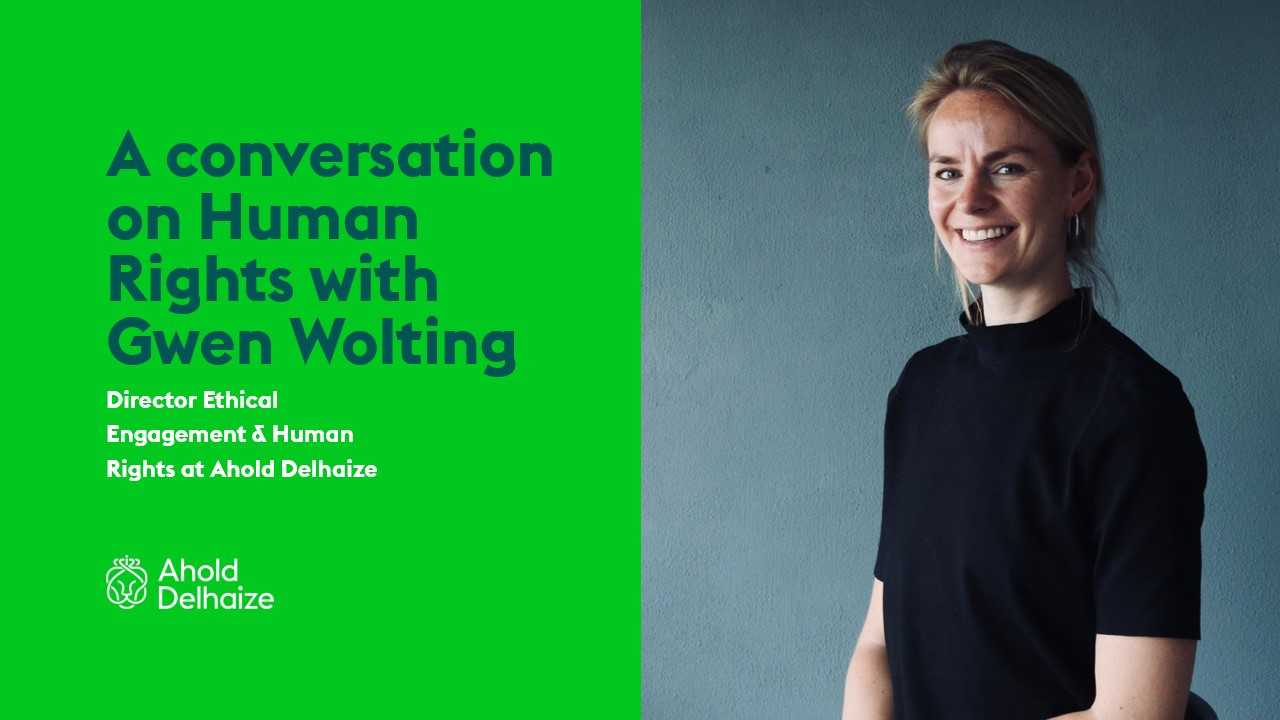
A conversation on Human Rights with Gwen Wolting
September 14, 2026 – Today, Ahold Delhaize introduces our updated Position on Human Rights, reaffirming our commitment to respecting and promoting human rights across our operations and value chain.
The updated Position provides greater clarity on how we put our human rights commitments into practice. Its aim is to serve as a reference point for associates, suppliers, customers and other stakeholders.
To learn more about the key updates and what they mean in practice, we spoke with Gwen Wolting, Director Ethical Engagement & Human Rights at Ahold Delhaize.
1. What draws you to this work, and was there a particular moment or experience that made this topic personally meaningful to you?
“I've always had a strong sense of empathy and a desire to stand up for people who don't always have a voice. For many years, I pursued that passion through volunteer work, including with the Food Bank in Amsterdam. A defining moment came in early 2024, during a six-month sabbatical in South Africa and Zimbabwe, part of which I spent working on farms. Seeing firsthand the hard work that goes into producing the food and flowers we consume every day, and working alongside the people who make that possible, gave me a much deeper appreciation of the human side of global supply chains.
That experience made me realize that I wanted to work closer to these supply chains and contribute to improving conditions for the people within them. Being able to do so through my role at Ahold Delhaize is a genuine privilege. It gives me the opportunity to ensure that human rights remain a top priority on both our internal and external agendas, and I'm fully committed to continuing that work. The more I learn about the realities people face, the stronger my conviction becomes that businesses can and should be a force for positive change, and I want to play my part in making that happen."
2. What is the main focus of our updated Position and why do we as Ahold Delhaize have such a document?
"Our Position on Human Rights, which was first published in 2017 adhering to international frameworks that we commit to, outlines our commitment to respecting and promoting human rights across our operations and supply chains.
Ahold Delhaize’s operations and supply chains involve hundreds of thousands of associates and even more workers in our supply chains globally. Given our scale, our decisions (e.g., how we source, how we supply, how we manage our workforce) directly affect people’s working conditions. Our Position sets out our approach to human rights due diligence for both our own operations, and our broader supply chain, which includes tens of thousands of suppliers and vendors. It explains how we identify, prevent and address the risks associated with operating at this scale. It is based on internationally recognized frameworks, including the UN Guiding Principles on Business and Human Rights (UNGPs) and the OECD Guidelines. Our scale and reach come with responsibility, and this document captures that.
Our Position on Human Rights gives our brands’ associates, suppliers, and customers a clear reference for what we require and what they can expect from us. At its core, our commitment to do what is right is based on our collective belief that all people should be treated with dignity and respect."
3. In your words, what are the most important changes to understand about this updated position?
"Our updated Position provides more clarity on how we aim to deliver on commitments that we’ve made. In addition, we have considered upcoming legislation, including the Corporate Sustainability Due Diligence Directive (CSDDD), which will apply to our entire company due to our listing in the Netherlands. The directive requires companies to conduct human rights and environmental due diligence throughout their operations and value chains.
This is reflected in our risk-based approach to addressing the areas where the highest risk prevails, such as countries where governments may fall short on safeguarding workers’ rights. We have included our salient impacts and provided more information on our social compliance and critical commodities programs. With this, we’re providing more clarity on our human rights approach within Ahold Delhaize and beyond. The word “beyond” is used deliberately. Human rights issues are often systemic and therefore rarely isolated. Solving them is a collective responsibility and therefore requires a true value chain approach to work. This is why industry collaboration in the supply chain is a key and integral part of our Position. We will continue to use our Annual Report to report on actions, learnings and next steps on human rights."
“Our commitment to do what is right is based on our collective belief that all people should be treated with dignity and respect.”
4. What internal processes give you confidence that our commitments translate into practice on the ground?
"At Ahold Delhaize we have strong governance, a clear Position on Human Rights, supplier requirements through our Standards of Engagement, a social compliance program for Own Brand suppliers with production locations in high-risk countries, our critical commodities program and our Speak Up Line that all help translate our commitments into action.
In addition, our brands take ownership across a range of human rights issues in their operations & supply chains as well. And I believe our commitments are increasingly integrated into how brands engage with suppliers and conduct their business.
At the same time, human rights is an area that requires continuous attention and engagement. Supply chains are a good example: they are constantly changing, and so are the risks within them. To identify these risks early, we need to continuously invest in due diligence, engage with stakeholders, and stay alert to where gaps are forming. So, it’s not that we assume we have all the answers. It’s the iteration and the willingness to listen and act on what we find that gives me the confidence we’re on the right path."
5. What excites you most about where this work is heading? And what changes do you expect in the human rights field in the coming years, and how does this update help us prepare?
"What excites me most is that human rights are increasingly becoming a core business consideration rather than a standalone topic across our industry. The industry is moving beyond commitments and compliance towards embedding human rights into everyday business decisions, where we can create real impact.
Looking ahead, I expect greater collaboration with stakeholders, increased transparency, and a stronger focus on demonstrating outcomes. This shift is coming and over time, companies will increasingly be expected to show real impact on worker and community conditions, not just prove that they’ve responded when issues arose.
This update is a step toward preparing us for that future. Most importantly, human rights is about making a positive difference in people’s lives. That’s what makes this work so meaningful to me."
Read the full Position on Human Rights here.