

From billions in savings to the effect on daily groceries: 10 questions on keeping food affordable
The people behind a decade of Ahold Delhaize
July 8, 2026 – Ahold Delhaize was born 10 years ago this summer, when Dutch retailer Ahold N.V. merged with Belgian Delhaize Group, crossing borders to create a strong, customer-focused retailer that today spans 9 countries and 17 great local brands. As we celebrate this milestone, we’re launching The 10 Series: we'll be asking colleagues across the company to share their perspective on 10 topics they're closest to.
Ahold Delhaize operates in a world where grocery affordability is under real pressure, from global supply chain shifts to persistent inflation. Keeping food accessible for millions of families while maintaining a healthy, low-margin business is a daily reality.
At the heart of how Ahold Delhaize manages this is Save for Our Customers; a group-wide cost savings program that finds efficiencies across the business and reinvests savings back into customer value. We sat down with André Blesing, Senior Vice President of Business Planning & Performance, to find out how.
1. How is this more than a savings target?
“Save for Our Customers is not just about cutting costs. It is about creating a mindset across the organization: every euro we save can help us invest in better value for customers. It should constantly challenge you to ask: can this be done better, simpler, or more efficiently? Not just to make things cheaper, but to create room to invest where it truly adds value for the customer. It has three clear elements:
- Buy better It starts with making sharp, well-considered choices in what and how we purchase. It’s not only about price, but also about quality, supplier partnerships, and long-term value.
- Operate smarter How do we organize our work? Can processes be simplified, automated, or can we eliminate duplication? There is often a lot of untapped potential here to become more efficient without compromising quality.
- Waste less This can relate to time, resources, energy, or physical goods. Everything we don’t waste can be used for something that truly matters.”
Blesing: “This efficiency strategy is backed by a highly successful, audited track record of execution. Ahold Delhaize is known for consistently delivering on its savings targets. Year after year, the Save for Our Customers initiative has successfully generated between €1.25 billion and €1.3 billion in annual savings, establishing the foundation required to navigate the macroeconomic environments for the company and its customers. It allows us to continue investing in better and healthier own-brand products, lower prices, and a stronger value proposition for our customers, while supporting our broader Healthy Communities & Planet ambitions”
2. The ambition is growing
“Scale remains one of Ahold Delhaize's greatest assets, and the company is continuously elevating its efficiency targets. Between 2025 and 2028, the group is aiming for €5 billion in cumulative savings. We will achieve this by stepping up joint sourcing, applying AI and automation in logistics, distribution, store operations, and back-office functions, and by simplifying and refining our operating model. This allows us to operate both more efficiently and more sustainably.” Blesing says.
3. How cost savings help fuel growth.
Blesing: “The Save for Our Customers program directly drives Ahold Delhaize’s broader growth model. By systematically eliminating operational waste, the company generates the necessary financial room to invest back into the business. This structural efficiency allows local brands to invest in their winning customer value proposition, including lower prices and fund innovations, which in turn drives higher sales volumes and market share, creating a cycle of growth.”
“Every euro we save gives us more room to invest in what matters most: affordable groceries, better service and stronger local brands.”
4. How AI helps to predict what customers need.
Technology is fundamentally reshaping inventory management, enabling local brands to move to highly predictive models. What makes this shift possible is our ability to reinvest savings into advanced capabilities like AI.
As Blesing explains: “We deliberately use the funds generated through Save for Our Customers to invest in technologies that drive further innovation and efficiency. Advanced AI systems allow teams to analyze store operations end-to-end. By leveraging historical data, we create hindsight, generate real-time insights into shelf movement, and build predictive foresight.”
By incorporating variables such as weather patterns and seasonal demand, these systems can forecast with higher precision. This is clearly illustrated by Albert Heijn’s dynamic markdown capability, where products approaching their expiration date are automatically offered at reduced prices in-store to help prevent food waste. The result is a triple win: reducing food waste while offering better value to customers and protecting margins.
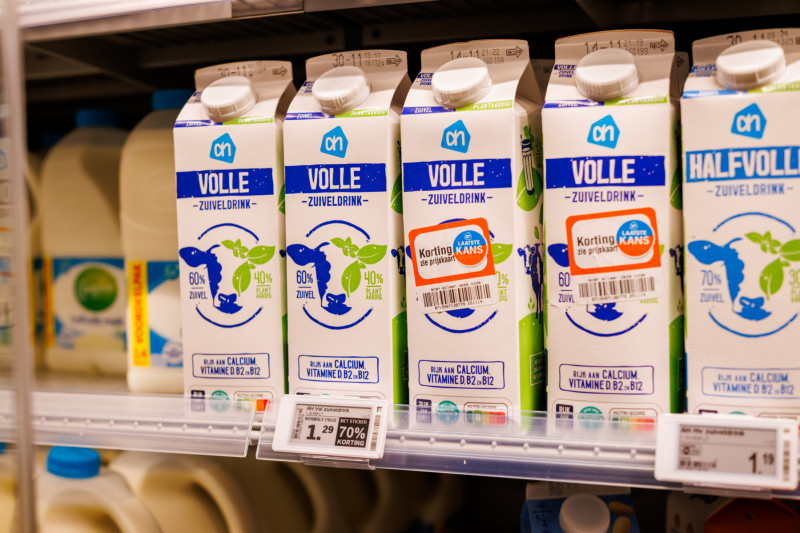
Ultimately, this shows how savings are not an end in themselves - they are a means to fund smarter, more future-proof ways of working.”
5. How local brands benefit from a shared scale.
Blesing: “Ahold Delhaize operates a decentralized family of local brands and utilizes global and regional scale to provide competitive edge. For example, European brands are increasingly aligning product specifications to source high-volume items collectively. By consolidating purchasing volumes and harmonizing requirements, such as shared ESG (Environmental, Social, and Governance) certification standards, the group drives major procurement efficiencies without compromising quality. It even improves quality and service for customers.”
6. How cost savings also improve the workday.
Blesing: “By structurally reducing costs, Ahold Delhaize frees up resources to focus on what truly matters for our customers. It’s not about saving for the sake of saving, it’s about creating the capacity to invest in a better customer experience and supporting our teams where they add the most value. These efficiencies allow us to redirect time, attention, and investment away from routine or low-value activities, and toward areas where we can genuinely make a difference for shoppers, whether that’s improving service, enhancing assortment, or making shopping more seamless and convenient. A good example is how we invest in technology to support our people. Albert Heijn’s AI assistant, which is used daily by 80,000 colleagues across the organization, exemplifies this approach. The tool provides store associates with instant access to operational and product information, reducing complexity in their daily work. As a result, customers can receive accurate answers immediately, without associates having to search for information or consult another colleague.”
7. How the program funds a $1 billion commitment to lower everyday shelf prices in the United States
“The true power of organizational efficiency is realized when it directly alters the price tags on the shelves. A prime example of this is Ahold Delhaize’s commitment to invest $1 billion directly into lowering grocery prices across its U.S. brands between 2025 and 2028. The Save for Our Customers program acts as the funding mechanism for this initiative. By driving cost savings, including procurement, automation and simplification, the company can structurally lower the everyday cost, turning savings into a sustainable, long-term price promise at the register.”
8. Efficiency helps absorb rising costs. The program serves as a vital financial shock absorber against escalating upstream supply chain costs
“Before a product reaches a grocery bag, it navigates a complex, volatile and increasingly expensive global supply chain. Rising costs at the very beginning of the journey, such as escalating fertilizer prices for farmers or higher diesel or electricity costs for transport, threaten to push up retail food prices. Because Ahold Delhaize sits at the end of this value chain, its efficiency program successfully manages and partially absorbs these mounting global pressures behind the scenes, acting as a buffer that keeps the extra costs off the customer's final receipt as much as possible.”
9. A statue of a customer at the corporate headquarters stands as the ultimate anchor for the program’s consumer mission.
“This statue carries a clear and symbolic meaning. It represents the customer and is depicted as an everyday shopper carrying grocery bags, reflecting the reality of daily life. The statue was unveiled in 1990 during the opening of the headquarters and bears a powerful message: ‘Opdat wij nooit vergeten voor wie wij werken’ - 'So that we never forget who we are working for.’”
Blesing: “The statue serves as a physical reminder that everything we do is for the customer. Every decision should ultimately make life better, easier, or more affordable. Building on that principle, the combined strength following the merger created new opportunities to accelerate savings and reinvest them, enabling an even better, more affordable, and more compelling customer experience. And it continues to do so today.”
10. A personal question: when you've had dinner at a restaurant, do you always check the bill before paying?
Blesing: “Yes and no — I generally have a rough idea of what the bill should be, and whenever it deviates, I always check it. In almost all of these cases, it turns out to be incorrect. This can go both ways: just last week I had a restaurant bill that was lower than expected, and when I checked, I noticed they had missed two coffees and some desserts, so I asked them to adjust it. At our last team event, they even added another table to our bill. It’s really worthwhile, both privately and at work, to always check the bill and, if necessary, challenge it.”
This article is part of a 10-part series celebrating 10 years of Ahold Delhaize. For a decade, Ahold Delhaize brands have been trusted partners in millions of customers’ daily moments, operating at the heart of local communities. We’ve built a strong foundation in those 10 years – but this is only the beginning. In this series, we look back at where we came from and forward to the future, through the eyes of the people who are making it all happen.