

Moving millions of products daily: 10 questions about the complex logistics of grocery retailing
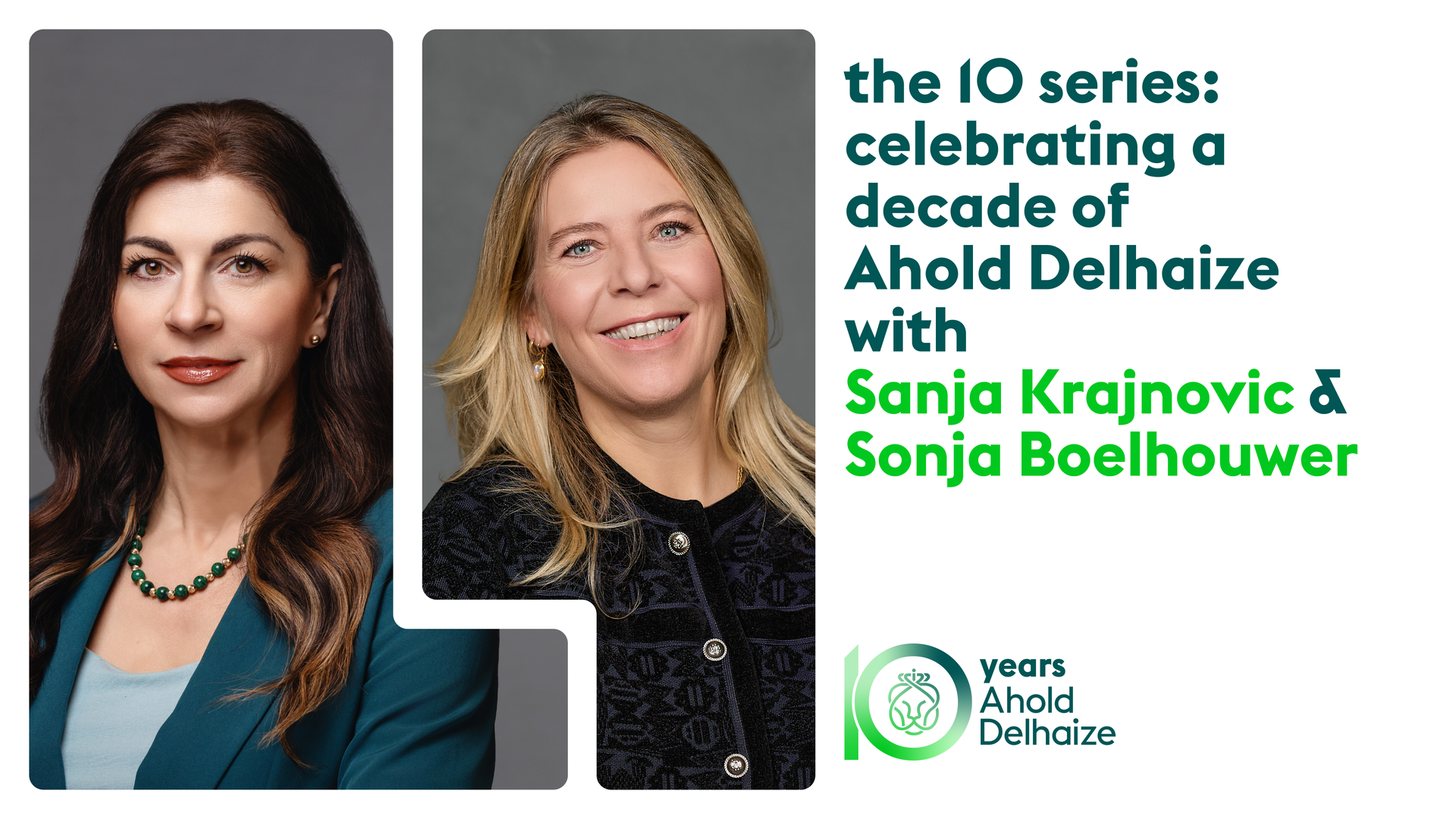
The people behind a decade of Ahold Delhaize
November 20, 2026 - Ahold Delhaize was born 10 years ago this summer, when Dutch retailer Ahold N.V. merged with Belgian Delhaize Group, crossing borders to create strong, customer-focused retailers that today span nine countries and 17 great local brands. As we celebrate this milestone, we'll be asking colleagues across the company to share their perspective on 10 topics they're closest to.
Ahold Delhaize USA’s Chief Supply Chain Officer Sanja Krajnovic and Albert Heijn’s Director of Omnichannel Operations Sonja Boelhouwer are responsible for ensuring that products find their way from suppliers around the world all the way to our brand’s stores and ecommerce operations, day in and day out. And it’s not an easy job. We talked to them about the challenges they face, how customer needs and supply chain operations differ between the U.S. and Europe, and why, in a field that’s becoming more tech-enabled every day, the role of people is so important.
1. Can you give us a snapshot of your respective supply chain networks?
Sanja: “The ADUSA Distribution and ADUSA Transportation networks are one of the largest distribution networks along the East Coast, spanning from Maine to Georgia. It supports five omnichannel grocery brands – Food Lion, Giant Food, The GIANT Company, Hannaford and Stop & Shop – serving over 26 million customers each week. At ADUSA Distribution, we operate more than 20 distribution centers, and the U.S. brands have another 1,700 pick-from-store locations. In all that we do, we remain close to customers as their needs shift and evolve to support current trends but also future brand growth.”
Sonja: “Our network serves more than 1,250 Albert Heijn stores throughout the Netherlands, while our in-house e-commerce capabilities enable us to offer nationwide home delivery. We have six distribution centers and nine home shop centers. While it is a small country – one-third the size of Pennsylvania – it's densely populated, with over 18 million people. So, we have a lot of smaller stores. Since many customers have small refrigerators and cars, they shop frequently or even daily. This scale, infrastructure and density drives our supply chain strategy.
“While we offer 25,000 SKUs, because of our small store size, we have no back rooms. This means we carry very low inventory, and deliveries need to happen at a very rapid pace. Stores get fresh, non-perishable, frozen and bakery deliveries daily – sometimes multiple deliveries per day.”
2. What kinds of customer trends are you seeing right now that impact supply chain – and do they differ in the U.S. and the Netherlands?
Sonja: “I think customer behaviors are quite comparable across the U.S and the Netherlands. Customers are looking for easy, fresh and affordable. In the Netherlands, we have a very large penetration of fresh products and own brand – which makes up over 55% of our assortment. The U.S. is also moving in this direction, but we are further along.”
Sanja: “I agree that many trends are similar across both countries. Customers are looking for value more than ever before while also prioritizing convenience. Health and wellness is a huge trend impacting our businesses. The use of GLP-1 medications is growing rapidly, and these customers are eating less and shifting away from center-store snacks and beverages toward fresh products and higher-protein options.”
3. How are you adapting your supply chain strategy to meet these customer needs – does it differ between Europe and the U.S.?
Sonja: “To serve customer demand for fresh and innovative products, we work with strategic partners dedicated to Albert Heijn who source or produce all our fruits and vegetables and fresh products. That has a very significant impact on the supply chain because we’re working with only a limited number of suppliers who are fully integrated into our warehouse management systems. They are more an extension of our business than a traditional supplier relationship. This close partnership gives us the opportunity to innovate together so we can better serve our customers’ changing needs.”
Sanja: “As a supply chain organization, our aim is to be there for brands’ customers wherever they need us, however they want to shop, and through whatever channel they choose. As people look for easy, high-protein, and affordable meal solutions, we are adjusting our assortment and offerings to meet their needs.”
Interviewer: I imagine the supply chain organization also contributes to value by operating as efficiently as possible so savings can be passed on to customers.
Sanja: “That's exactly right. Our role is to anticipate and support brand growth while also driving efficiency to provide more value, so that value can be invested back into our brands and ultimately into serving customers.”
4. We talk a lot about local brands and knowledge sharing across Ahold Delhaize. Can you share examples of logistics innovations that have been successfully shared between Europe and the U.S.?
Sanja: “Yes. As part of a global organization, we’ve been able to learn from and leverage each other's experiences. At the end of the day, we're dealing with many of the same challenges, including driving efficiency and creating value for our brands.
“There's a lot of new technology and automation available, and we work hard to keep communication channels open so we can share ideas, experiences and lessons learned. We meet regularly and continue to exchange ideas. Collectively, that makes us much stronger as an organization. We're excited about the opportunities that emerge when our teams get together and discuss different approaches.”
Sonja: “Across Ahold Delhaize, we have several global focus areas (GFAs), in which we gather experts from across the brands to share knowledge and drive progress. One of these is mechanization. Mechanizing distribution centers is a project you probably only do once or twice in your career, so we work very closely together on those projects and learn a lot from each other. Innovation, for us, doesn't stop at borders. We also have a GFA focused on AI that's gaining speed, not only in customer-facing applications but also in forecasting and demand planning. There is a lot of learning, sharing and implementation in both technology and operations.”
5. Is it easier to pilot and scale innovation in the U.S. or in Europe?
Sanja: “I don't see a major difference. Automation is automation. Technology is highly transferable. That's one of the nice things, because it allows us to learn from each other. The size and scale may differ, transportation can differ and regulations and compliance requirements vary, but the core innovation is usually applicable across both markets.”
Sonja: “I totally agree. There are nuances, but a box is a box. If the mechanized process works on one side, it works on the other side. You can make it as complicated as you want, but fundamentally it's about the same. We have the same temperature zones and many of the same operating requirements. There are more similarities than differences. For example – bananas are the number one item in both the U.S. and the Netherlands.”
6. In today’s volatile external environment, what challenges are you facing and how are you working to build more resilient supply chains?
Sonja: “When we talk about resilience in Western Europe, it's not just about geopolitical issues; we’re facing climate-related challenges as well.
“Supply chain resilience is a challenge across Western Europe. An extreme heat wave this year in the Netherlands put pressure on our refrigeration infrastructure. During the peak of summer heat, we sold ten weeks' worth of ice cubes in only a few hours – and drought conditions in France and Spain made water availability a real challenge.
“We are investing to become more resilient, build more flexibility into the system, and reduce dependency on just one or two suppliers. This includes upgrading our refrigeration and investing in generators.
“And sometimes it’s also about educating consumers. Our customers are very used to, for example, having strawberries in the winter. This may still be possible, but there are increasingly limits that are outside of our control.”
Sanja: “Supply chain resilience is so essential to running the business. As Sonja mentioned, there are often things you can’t control, like the weather. What we focus on are things we can control, investing where appropriate and having a strong business continuity plan. For us, it’s all about being proactive and anticipating potential obstacles so we can take care of our stores in the best way possible.
“We’re also used to dealing with major weather disruptions in the U.S. For example, this was the two-year anniversary of massive Hurricane Helene, which had a significant impact on some of the U.S. brands. It was an ‘all hands on deck’ situation to take care of stores, provide food for customers and help the community. We rallied together to implement our plans and find creative ways to get product to customers who needed it.”
7. Is the way you deal with these things different across the two countries? And does being part of Ahold Delhaize help?
Sanja: “Our stores are generally bigger, but we also have stores with almost no back rooms, and inner-city stores with restrictions around delivery windows. Even without major disruptions, everyday business is challenging and there is a lot of complexity in the supply chain. We have to continue adapting while staying focused on taking care of customers.
“Our goal is to stay close to our customers and brands so that if anything changes, we're aware of it and can adjust deliveries as needed. That's what makes this work exciting. It's very complex, constantly changing, and that is really part of the appeal.”
Sonja: “It’s definitely a benefit being part of Ahold Delhaize because we can learn from each other. For example, when we decided to invest in generators, we contacted the U.S. team to understand how they organize it. This is why it’s so helpful that our logistics teams come together regularly – we have those connections in place when we need them.”
8. Where do you see AI making the biggest immediate impact, and are there differences between Europe and the U.S.?
Sanja: “We’re all trying to solve similar problems, driving efficiency and figuring out how to use technology and data analytics to make better decisions. We never want to sacrifice safety or our culture, but if a tool can help create efficiencies or reduce time, that's valuable. It could be recruiting, data analytics, replenishment, or other functions where large amounts of data need to be summarized quickly to identify opportunities. The goal is not replacing teams. It's assisting teams.
“The key is being very surgical about where you apply the next use case. One of the most valuable things we've done is remove some of the buzz and determine where AI is useful, where it's not, and how we can learn collectively.”
Sonja: “The GFA helps here as well. We’re looking together across brands at where we should focus resources, where we should learn, and how we make AI applicable across the organization. It's both top-down and bottom-up, which works especially well in an area that's changing as rapidly as AI.”
9. How are we automating distribution centers without losing the human expertise needed to run them safely?
Sanja: “Our Burlington, N.C., distribution center is an excellent example of investing in technology while still valuing our most important asset, our team. This massive, 1.1 million-square-foot automated distribution center will ship 135 million cases annually through a combination of highly automated and manual solutions. Even with automation, we'll still employ more than 500 skilled associates when it's fully operational.
“Automation is a great way to increase capacity, drive efficiency, and enable some of the work, but it doesn't replace our people. That's really important for us as we think about supply chain in the U.S.”
Sonja: “It's 100% the same here. We’re facing a labor shortage and increasing ergonomic requirements and regulations – automation can help with both.
“People increasingly see it as an opportunity. The jobs are still there, but they require different skills and provide new opportunities for people to learn and grow – in work that is less physically demanding.
“No matter how much technology can help us, we're still in the people business. Engagement and connection matter. In any business where people work, that human element matters.”
Sanja: “I totally agree. The true power of our business is our people. Automation and technology should assist them, make jobs easier and safer, but thinking is still required. We also want to maintain a great culture and create an environment where associates can build long careers with us.”
10. Can you tell me more about how you are transforming the traditional distribution center role into an attractive long-term career?
Sanja: “We're focused on creating an environment where people feel safe, cared for and engaged. We invest heavily in onboarding, training, development and career progression, and it's incredibly rewarding to see people grow their careers with us.
“For example, we have an Emerging Leader Program where hourly associates with strong performance and aspirations can develop into supervisory roles. We have many success stories from that program. If warehouse workers want to become drivers, we'll pay for the training and licensing required to help them get there.
“ADUSA Distribution and ADUSA Transportation are proud to have been recognized as a Top Employer for several years. Our internship program has been particularly successful. This year we ranked fifth out of 150 companies in the U.S. for overall supply chain internship experience.”
Sonja: “In the Netherlands, it’s similar – we put a strong focus on associate well-being, training, development, leadership and ergonomics. As business becomes more technology-driven, the skills and capabilities we need are changing. We need associates to be digitally savvy, to work with terminals, robotics, automation systems and advanced technologies.
“I don’t think many young people are aware of the dynamic careers that can await them in our supply chain organization. I recently took a friend’s son, who studies econometrics, and some of his classmates on a tour through one of our automated distribution centers. They were incredibly excited to see how much mathematics, planning and optimization happens behind the scenes. People shop at Albert Heijn every day, but they don't realize supermarkets need those kinds of skills.”
Sanja: “That's such a great point. Historically, grocery supply chains weren't viewed as especially innovative. That perception is changing.
“When students see the breadth of opportunities, from HR to automation, technology, AI and complex problem solving, they're often blown away by how many career paths are available.
“And it's all connected to a very clear purpose. Yes, we're moving boxes, but those boxes are incredibly important to people's lives. That's something everyone can relate to.”
This article is part of a 10-part series celebrating 10 years of Ahold Delhaize. For a decade, Ahold Delhaize brands have been trusted partners in millions of customers’ daily moments, operating at the heart of local communities. We’ve built a strong foundation in those 10 years – but this is only the beginning. In this series, we look back at where we came from and forward to the future, through the eyes of the people who are making it all happen.