

Removing barriers: 10 questions about how we’re working towards a healthier future
The people behind a decade of Ahold Delhaize
September 30, 2026 – Ahold Delhaize was born 10 years ago this summer, when Dutch retailer Ahold N.V. merged with Belgian Delhaize Group, crossing borders to create a strong, customer-focused retailer that today spans nine countries and 17 great local brands. As we celebrate this milestone, we'll be asking colleagues across the company to share their perspective on 10 topics they're closest to.
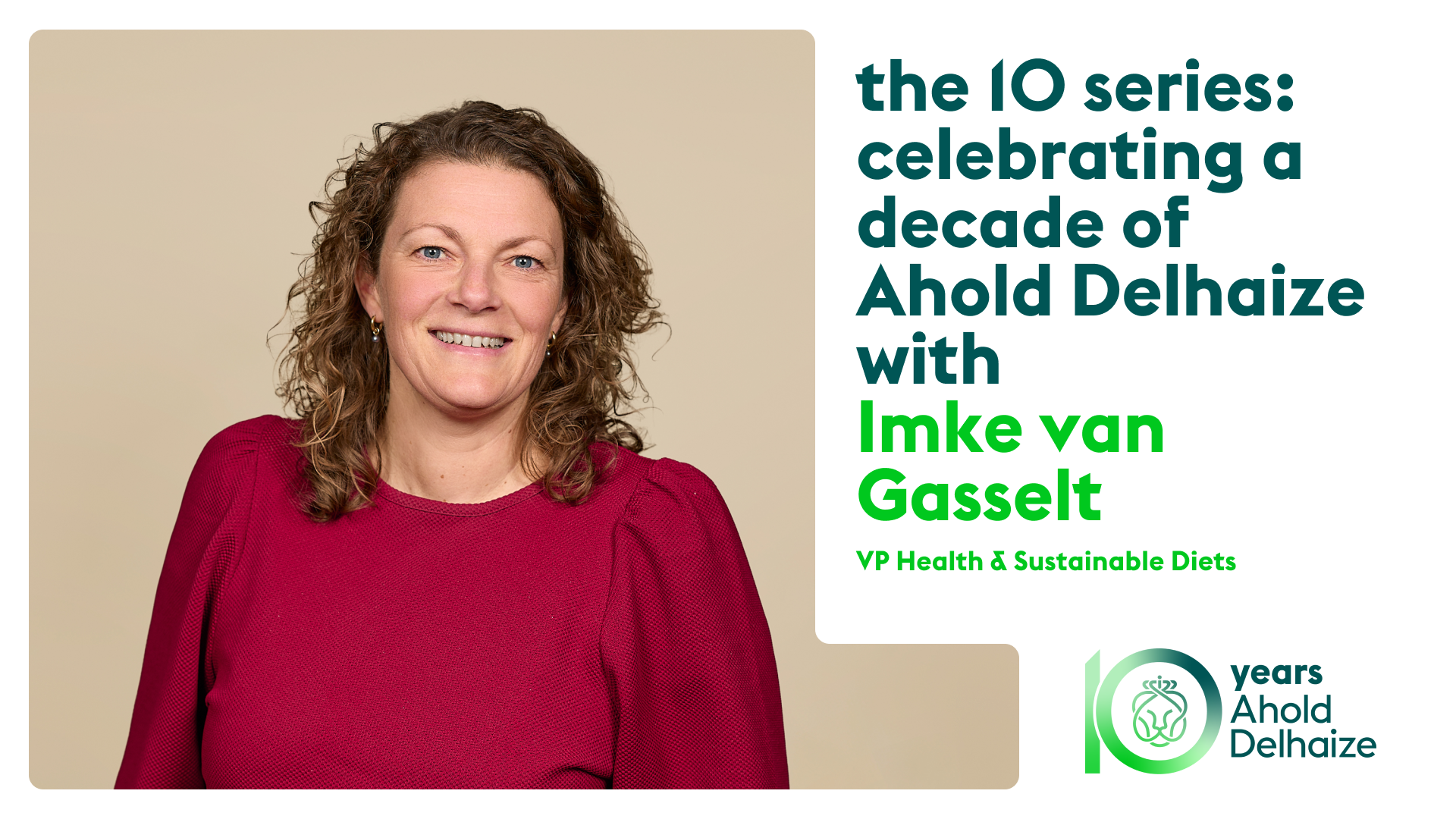
As VP Health & Sustainable Diets, Imke van Gasselt helps Ahold Delhaize take on a credible, consistent, and commercially relevant leadership role in the field of health – and that our approach is understood across the company. We talked to her about the strategic step up Ahold Delhaize is taking in its health strategy – including a significant shift in the company’s healthy sales KPI – what her team is learning through research and conversations with stakeholders across the food system, and how greater collaboration can help remove barriers to healthy eating.
1. How has Ahold Delhaize’s approach to health evolved in recent years?
“Since Ahold Delhaize was formed ten years ago, health has been high on our agenda. Today, it’s an important strategic priority for us and integrated into our company’s purpose. Recent societal trends – from increasing attention to ultra-processed foods to the growing use of GLP-1 medications – are bringing conversations about diet and health further into the public discussion, and we believe there is an opportunity to accelerate progress, both within our own business and across the wider food system.
“To this end, we recently took a major step up on health in our strategy. Our healthy sales target had been focused exclusively on own brands. This was a great first step, but we wanted to make it even more relevant. Starting this year, we’re measuring ‘total store healthy food sales’ – changing our target from a percentage of healthy own-brand products to a percentage of healthy food items across all product ranges. This new metric will help us encourage consumers to make better choices throughout our assortment.
“As we strengthen our focus on health, we want to better understand the barriers that prevent people from eating healthier and identify where the greatest opportunities for impact exist. Through research and engagement with stakeholders across the food system, we have gained valuable insights that reinforced both the urgency of the challenge and the need for collective action.
“Because we believe no single organization can solve these challenges alone, we are working to share our insights in a research paper in October. We hope it will support conversations across the industry and encourage collaboration among retailers, manufacturers, policymakers, and other stakeholders to help make healthier diets more accessible."
2. What are some of the most interesting findings your research has uncovered so far?
“Across markets, we see that healthy eating is relevant for almost all consumers, but most people are having a hard time reaching their goals. While 92% of people we’ve surveyed want to change their diets to be healthier, only 14% believe that their diets are ‘very healthy.’ And only 13% feel ‘very confident’ that they can identify healthy options.
“Our research also highlights that motivations for healthier eating differ across countries and consumer groups. For example, in some markets, people are primarily motivated by weight management, while, in others, they are focused on gut health or driven by price. Understanding these differences is critical if we want to help people make healthier choices in ways that are relevant to their daily lives.”
3. How is Ahold Delhaize making healthy eating more accessible and affordable?
“For us, it comes down to making healthy choices easy and making healthy living a habit. We have a healthy living framework that guides our approach and consists of three clear steps. First, make it easy. This is about making sure the right, healthy options are simply available. Our local brands are doing this in countless ways, and own-brand ranges are an important tool they use to do this in a way that is both relevant and affordable.
“Second, make it a habit. This includes efforts like providing information, engaging dietitians and offering educational programs.
“And third, make it a lifestyle. This is already reflected in some of our brands’ digital apps, which not only help people improve their nutrition but take a broad, holistic approach to healthy living – including in areas like getting enough sleep and reducing stress.”
4. Can you tell us about some of the barriers that people face when striving towards a healthier lifestyle?
“As people try to eat – and live – healthier, they not only face personal challenges, but also obstacles that are built into our systems and environment and over which they have little control. Healthy living is not one-dimensional. Many aspects of lifestyle are connected – and food is an important part of it.
“For example, if you sleep better and move more, you're also more likely to eat healthier. But as people try to be more active and eat better, the system is not necessarily built around making those choices easy. And it goes beyond food. Our cities and suburbs have largely been built around convenience and affordability. It’s not always easy to get around without a car, or to take the elevator instead of the stairs.
“And even if retailers provide healthy food choices for parents to feed their families, the environment can make it challenging. There may be fewer nutritional snacks available at school or at sports practice, or snack bars nearby offering kids hard-to-resist food options like French fries. So, it’s not just a food retail issue, it’s a system-wide issue.
“That's what makes health such a complex and difficult challenge.”
‘’Healthy living is not one-dimensional. Many aspects of lifestyle are connected – and food is an important part of it.’’
5. While this is clearly a challenge that requires cooperation across the supply chain, what role can retailers play to help customers move toward healthier diets?
“It’s true that because health is such a systemic challenge, we, as food retailers, absolutely cannot solve it on our own – the entire local ecosystem must change. If a customer walks out of the supermarket and immediately buys an unhealthy snack from a street vendor next door, we’re not making progress overall. However, food retail is well placed to help lead the change, having a direct connection to shoppers at the moment of choice.
“To get to meaningful, practical change across the system, we need to align healthier outcomes with commercial outcomes. In our soon-to-be published research paper, we will outline three main barriers that stand in the way of people making healthier choices. For each of them, we will identify practical ways to help bring those barriers down that can inspire action across food retail.”
6. What role do manufacturers, NGOs and policymakers play?
“Manufacturers can make a positive impact through efforts like creating healthier assortments and reformulating products to contain healthier ingredients – for example, cutting sugar and salt. For policymakers, it's about helping to change the environment more broadly and create a level playing field and working towards policies that support stronger health outcomes. This goes beyond supermarkets – it involves the wider food environment and the systems that influence consumer choices.”
7. You mentioned your research has found that motivations vary by market. How does having strong local brands help?
“Our local brands are very close to their customers and communities – this enables them to understand those differences in motivations and behaviors and meet consumer needs with the most relevant product offering and support. This is the exact reason why our local-brand model is so important, and such a differentiator for Ahold Delhaize.”
8. How do sustainability and health intersect in your strategy?
“Even in times when sustainability might not be top of mind for consumers, we know from our research that health is. For this reason, health can actually be used as the lens through which sustainability efforts are understood.
“A good example is the protein shift. Moving from animal-based proteins to plant-based proteins is a major sustainability opportunity, but it's also a health opportunity because it encourages people to eat more vegetables, legumes and plant-based alternatives.
“Health and sustainability are often connected through those kinds of choices.”
9. Looking ahead five to ten years, what innovation or collaborative initiative is most important for creating a healthier future?
“I don't think it's one thing. It's the total system.
“Creating a healthier future is such a complex challenge. It will require a combination of initiatives and innovations: reformulation, affordability, pricing, promotion, regulation – all working together. We need to move away from thinking it's about one product. It's about the full shopping experience and the full basket, with a health lens overlaid across everything.
“That doesn't mean people can't buy anything unhealthy. It means that, in the broader picture, the balance should be more healthy than unhealthy. Today, that balance is often not where it should be.”
‘’Creating a healthier future requires a combination of initiatives and innovations: reformulation, affordability, pricing, promotion.’’
10. What role can technology and data play?
“All kinds of technology can help, particularly if they make healthier choices easier.
“For example, in the online shopping journey, we can propose healthier alternatives when people click on a product. Loyalty programs can help guide people in a healthier direction. Personalization is also important, allowing people to receive personally relevant information based on the type of diet or lifestyle they're interested in.
“One thing we do know is that the more personal and relevant the information becomes, the more useful it can be. As retailers – but also across the industry – new technologies give us so many opportunities to get closer to our customers and help them make choices that lead to real, lasting healthy lifestyle changes.”
This article is part of a 10-part series celebrating 10 years of Ahold Delhaize. For a decade, Ahold Delhaize brands have been trusted partners in millions of customers’ daily moments, operating at the heart of local communities. We’ve built a strong foundation in those 10 years – but this is only the beginning. In this series, we look back at where we came from and forward to the future, through the eyes of the people who are making it all happen.