
Transforming retail: 10 questions about how AI is empowering associates, serving customers and driving sustainability
The people behind a decade of Ahold Delhaize
September 4, 2026 – Ahold Delhaize was born 10 years ago this summer, when Dutch retailer Ahold N.V. merged with Belgian Delhaize Group, crossing borders to create a strong, customer-focused retailer that today spans nine countries and 17 great local brands. As we celebrate this milestone, we'll be asking colleagues across the company to share their perspective on 10 topics they're closest to.
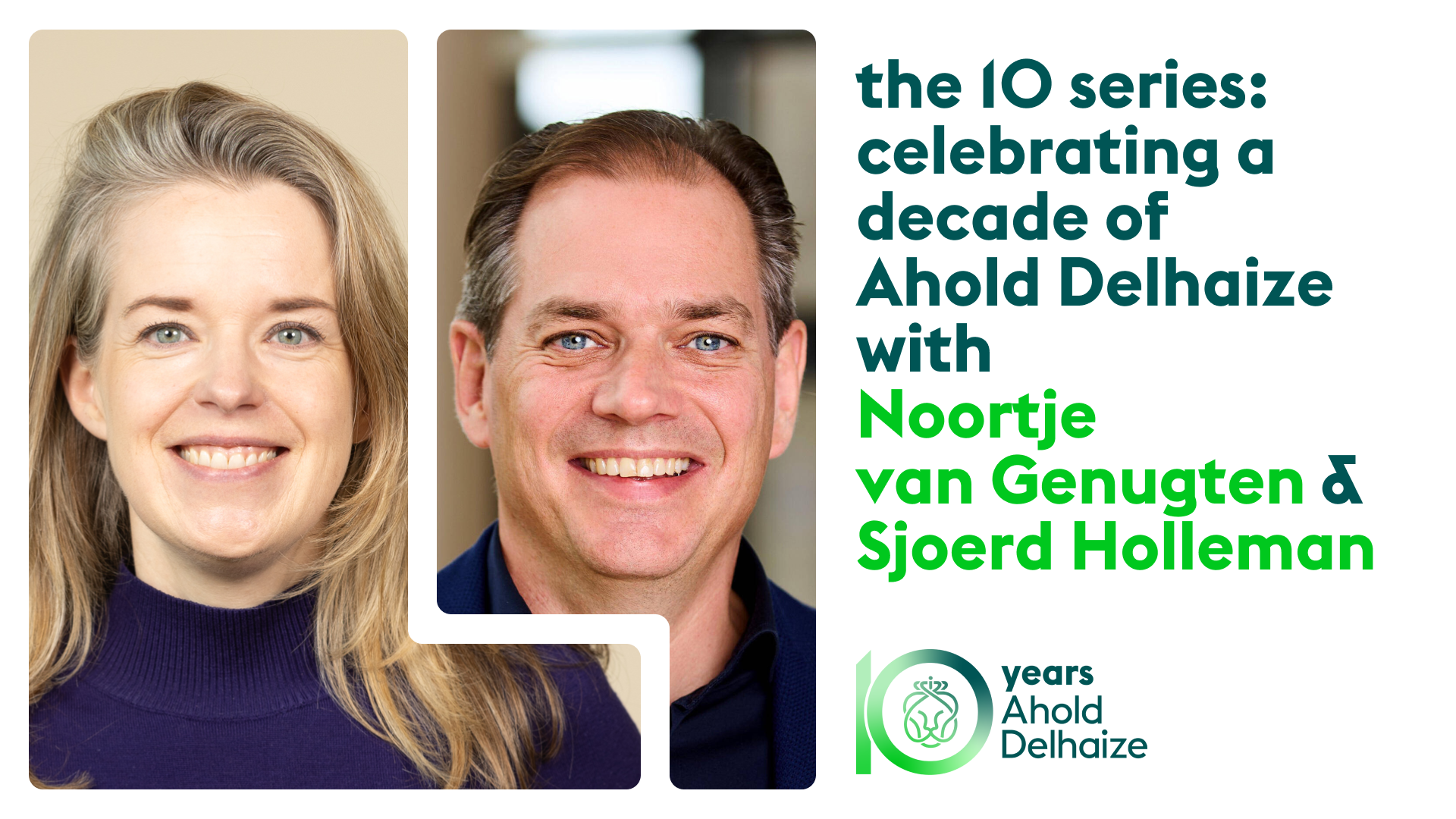
AI is having a growing impact on many areas of life, including retail – both in what customers can see and what goes on behind the scenes. Ahold Delhaize is leveraging the technology to improve the customer experience, empower associates and fight food waste. We talked to Sjoerd Holleman, member of the Board of Directors of Albert Heijn, responsible for Product, AI and Specialty Brands, and head of the team leading the global AI focus areas across the Group, and Noortje van Genugten, VP Product Operations for Albert Heijn, about how it’s already changing the way we work and what the future holds for AI in retail.
1. When implementing a new AI project, there’s a big difference between a successful pilot and something that can successfully scale. What have you learned about how to get that transition right?
Sjoerd: “The most important thing is to start small but with the end goal in mind. If you have your prerequisites early on, you can steer in that direction. We start pilots in one or two stores, and as soon as they prove successful, we start adding to that and seeing how we can scale. We'd rather fail fast but also scale fast.
“One thing we’ve built at Albert Heijn that has been incredibly helpful in translating business needs to successful projects is our Product Organization. It sits between tech and the business, acting as an ‘architect’ between the needs of the business and the talented engineers that actually build the projects to address them.”
Noortje: “We always want to build things that deliver value to our P&L, help us meet sustainability targets or help improve the customer or associate experience. Our Product Organization helps us get the most return on value from our tech resources and budgets by translating business needs and challenges to technical applications that can actually be built. And then it manages how the tech teams deliver so that what they build really meets the needs of our colleagues or our customers.”
Have problem seek solutionThe first step in any project is determining whether it’s actually worth solving using AI. The team’s approach is to use the simplest technology necessary to solve a problem, rather than jumping straight to AI – they take a “have problem, seek solution” rather than a “have solution, seek problem” approach. It’s important to ensure that they’re really solving the needs of colleagues or customers – and then it’s time to pilot and scale. |
2. Over 80,000 colleagues are already using Albert Heijn’s recently launched AI assistant for associates – initiating more than 50,000 conversations a week. What did it take, organizationally, to reach that level of adoption?
Noortje: “Before we build anything, we want to understand what associates are looking for and what problems they need to solve. So, before building the AI assistant, we rolled out a test app that used human power on the backend instead of AI. Associates could ask questions and our team answered them as quickly as possible. We found most questions had to do with products – their location in the store, in-stock level, price, promotions – so we focused on that as our use case and soon got 250,000 requests every month!
“The road to success is really understanding what's going on in associates’ work and not making assumptions. I have some funny stories about that. While we trained the AI assistant extensively before launch, we didn’t realize how the youngest generation of colleagues – a large part of our store associate group – would talk in one-word sentences. This posed some challenges. For example, the Dutch word for onion is “ui” – which the AI translated to “user interface”! You can imagine what happened when they typed “Dubai” instead of “Where can I find Dubai chocolate?” Also – we thought associates would want a voice-activated app rather than having to type, but our young colleagues saw that as the most awkward thing ever. Luckily, we asked them before we built it!”
3. Is it making a difference for associates?
Sjoerd: “Yes, it’s had a positive effect so far. Associates feel empowered because they can actually answer questions themselves. Customers are happier because they’re served more quickly. And managers now have time to focus on other areas of their work. So, it's really been a win-win-win!”
4. Sjoerd, you help to oversee AI for both the group and a local brand. How do you build shared infrastructure and knowledge across Ahold Delhaize without steamrolling the local context that makes each brand unique?
Sjoerd: “When we work together across the group, our first priority is to get the right people together to share knowledge, so we don’t reinvent the wheel. While the brands are very different, we’re also similar – we deal with stores, products and people – so it’s helpful to share experiences about what enabled each brand to create the most value or save the most time or money.
“The next step is to share infrastructure and platforms where possible because this doesn’t affect the local customer experience. If we have a platform that works, why not use it more broadly? To this end, we’re building an adaptive, LLM-agnostic platform where developers across Ahold Delhaize can work and run AI applications together. It is pretty industry leading and should give us a competitive advantage.
“Our next step will be to move into creating domain visions – thinking about, for example, what merchandising will look like in the future, what will be the role of AI, what's our vision on that and how do we work towards it – and then share those domain visions with each other.”
5. What is the AI application you're most proud of that people outside of the company probably don't know about?
Sjoerd: “We always talk about our employee and customer assistants, which we’re very proud of. But there are other applications operating behind the scenes that really make an impact. One great example came out of our yearly hackathon at Albert Heijn, where all our technology people – product owners, data science & analytics and tech engineers – come together and spend 24 hours working and sleeping in the office, focused on solving difficult challenges. They often come up with ideas that we actually deploy.
“Two years ago, the hackathon group created an AI layer that can sit between our systems and our customer app and automatically translate everything in the app to another language. With 1.2 million non-native Dutch speakers in the Netherlands, this is very helpful! Doing all these translations could have cost millions of euros, but our teams built the AI tool in 24 hours and could deploy it at hardly any cost. So now we offer our app in languages like Turkish, Polish, French and English – we keep adding more – which allows us to be inclusive and help many more customers. It really opened my mind about how AI can help us think out-of-the-box.”
“Two years ago, the hackathon group created an AI layer that automatically translates everything in the app to another language. With 1.2 million non-native Dutch speakers in the Netherlands, this is very helpful!”
Algorithms make the differenceBeing able to predict well is the difference between success and failure for retailers. Ahold Delhaize’s brands use technology to help them do that. For example, at Albert Heijn, they feed years of sales history along with information on seasonality, holidays, promotions and whether promoted products could either increase or cannibalize the sale of other products (think a sale on hamburgers increasing the sale of buns but decreasing the sale of sausages) into their algorithms to predict how many cucumbers or loaves of bread a specific store will sell on a given day. The models forecast every day, for every product, in every store – that's 17,000 products, times 1200 stores, times 50 days ahead – or more than one billion forecasts each day! |
6. Is it hard to convince people with a lot of retail experience to trust an AI model? And can you give me an example of how the AI replenishment forecasts are making a difference?
Noortje: “We started with our first simple forecasts back in 2003 and then made the switch to automatic replenishment after that, which has reduced waste and increased product availability.
“One thing we’ve learned is that it’s important to put as much effort into communication as developing the tools, to ensure that people understand the benefits and are willing to use them.
“For example, we recently launched an app in our bakeries that tells associates exactly which bread to bake in which baking round. Our experienced employees were used to deciding this for themselves, so we knew we had to communicate well to explain to them that the tool would really help them work more effectively and reduce waste. To explain the tool’s benefits, we held information nights at every store and used other communication tools, such as movies – the implementation program was almost bigger than the project to develop the app. We also had to make sure that we had a strong feedback loop with the stores, listened to what people told us, and improved the tool to meet their needs. It took some weeks but, in the end, it was successful and people are happy with it.”
Wasting less by optimizing safety stocksOne way the bakery app helps is with “safety stocks”: the extra product that we put out, in addition to the product we’re forecasted to sell, to make sure we don’t have empty shelves. The old tool tended to put safety stock out for every individual product. But our AI models have shown us that, for some product groups, customers see different products as being very similar. For example, we don’t need safety stock for 15 types of white bread, we just need to have the right types available. Knowing this helps us reduce waste in the store. |
7. Noortje, you mentioned waste. Combating food waste is a big priority for Ahold Delhaize. Do you have any examples of how AI is helping?
Noortje: “Yes, many! The first step in preventing food waste is always to stock the stores as closely as possible with what people want to buy. AI is helping us do that. We’re currently rolling out new algorithms that use AI assortment planning, to determine the correct product mix per store and assortment group.
“Secondly, we use AI to forecast customer demand and algorithms to determine how much of a product we should deliver to a store and when – like the production algorithm we use in the bakery app.
“Because we can never forecast perfectly, we use AI to dynamically mark down the cost of items on the shelves that are about to expire. These dynamic prices are automatically pushed to our Albert Heijn app and the electronic shelf label – the system reevaluates and updates every 15 minutes.”
8. What role will AI play in the fight against food waste 10 years from now?
Noortje: “My dream is that forecasting will someday be so precise that we will sell exactly what we bring to the store. When you think about it, food waste results from not having the insights needed to make the smartest decisions – and AI will continue to help us make better decisions.
“One huge benefit to AI is that it enables us to build simulation environments to test our replenishment algorithms in different scenarios in a way that is much faster and less costly than doing it physically in the stores. Customers don’t want to see empty shelves, so there’s always a trade-off between availability and waste, but AI makes these decisions so much easier than in the past by giving us the right data to support our decision-making.
“AI will also expand food waste reduction capabilities across the retail industry. While Albert Heijn is already a frontrunner in how we use technology to prevent food waste, generative AI will put these tools in reach for many other retailers.”
9. A lot of AI in retail focuses on the customer experience. But do you think the operational side – supply chain, product flow, efficiency – deserves more attention?
Noortje: “Yes, that's one of my favorite topics! Our supply chain is our most AI-intensive domain because it runs on optimization algorithms. I see it like a big Tetris puzzle – we know which articles to bring to a store, and we use optimization algorithms to fit them perfectly onto a load carrier in the distribution center, just like a Tetris game.
“We use also optimization algorithms to design perfect walking paths for associates as they move product around our distribution centers and to make sure we pack trucks with as little air as possible. ‘Invisible’ innovations like these enable us to save millions of euros, not to mention environmental impact, by operating more efficiently.”
10. I know when it comes to AI, it’s hard to look even two weeks ahead, but I'm going to ask you to look further than that. In the next two to three years, what's the shift in AI that you will matter most and that we're not talking about enough yet?
Sjoerd: “I think the agentic part is going to change a lot – both on consumer side and the organizational side. We're the last generation of leaders who will have only led humans. Upcoming generations will lead agents as well as humans. Agents will have an employee number, and will execute tasks around the clock together. I believe this will free up time for humans spend time on things that really add value. Humans will become more the orchestrators of these agents rather than executing all the work themselves. So, it's going to be very interesting.”
Noortje: “We are already trying to determine what processes will look like with agents. Today, store managers still spend a lot of time on computers and email, managing information and results and then processing and translating them into tasks for their associates. This takes them away from the many things happening in the store, and from customers and their feedback. We believe that if we can help store managers by taking all this information and breaking it up to tasks that can be distributed – maybe even automatically – the store manager will have more time to coach associates and interact with customers.
“We believe that AI will make our people more human – meaning that instead of doing repetitive but necessary tasks, they can actually spend time on things that humans are really good at.”
This article is part of a 10-part series celebrating 10 years of Ahold Delhaize. For a decade, Ahold Delhaize brands have been trusted partners in millions of customers’ daily moments, operating at the heart of local communities. We’ve built a strong foundation in those 10 years – but this is only the beginning. In this series, we look back at where we came from and forward to the future, through the eyes of the people who are making it all happen.