

Ahold Delhaize reports solid Q2 performance driven by sales growth; 2025 outlook reiterated
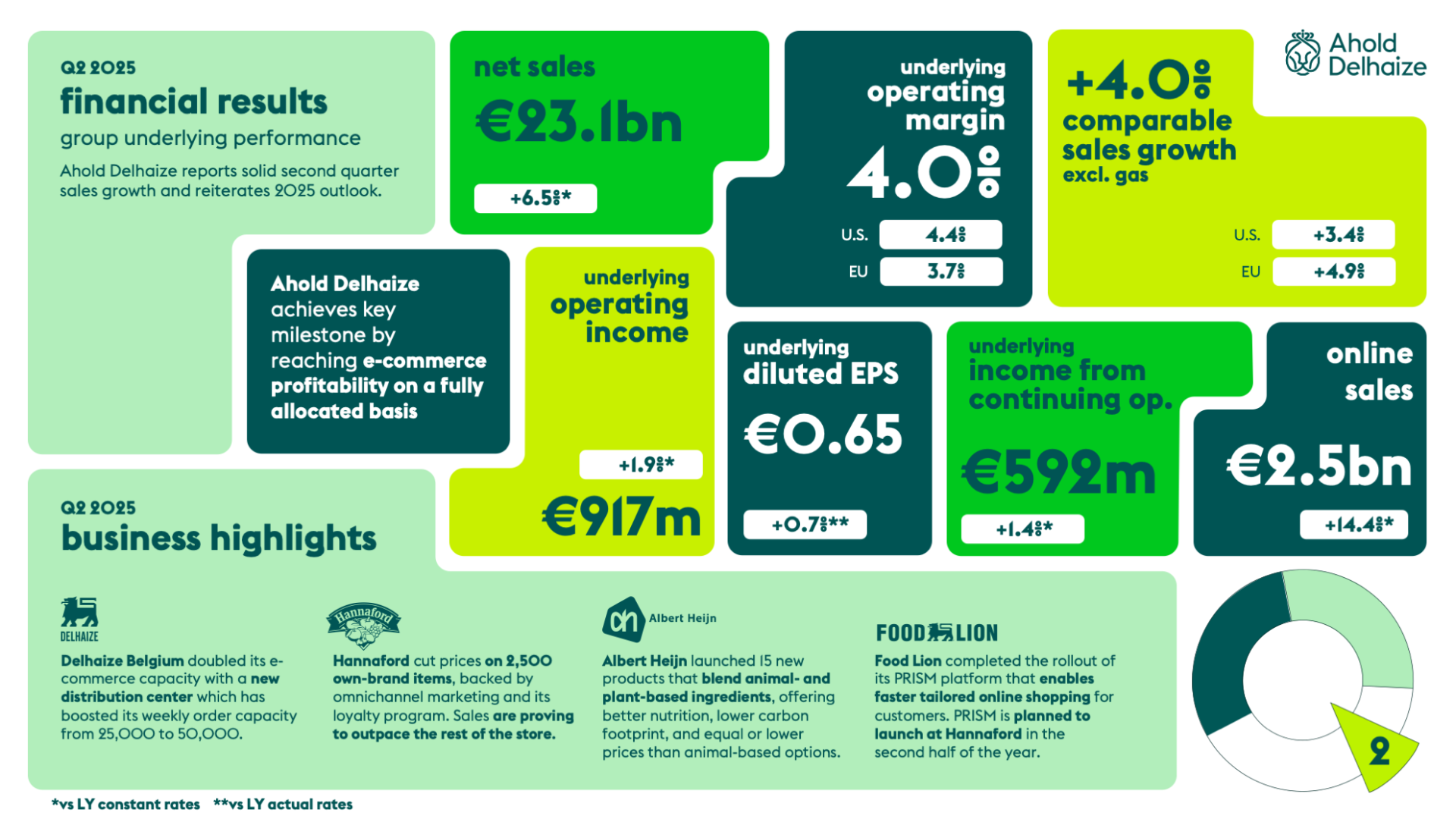
- Our Growing Together strategy ensures we deliver real value every day for our brands' customers through targeted investments in pricing, own-brand assortments and loyalty programs, as customers continue to feel pressure on their household budgets. Initiatives like these are strengthening our customer value propositions and driving sustainable, long-term omnichannel growth.
- In the first half of 2025, we already achieved a key milestone by reaching e-commerce profitability on a fully allocated basis. This underscores the strength and scalability of our omnichannel model, which is a key long-term driver of market share growth.
- Q2 net sales were €23.1 billion, up 6.5% at constant exchange rates and up 3.3% at actual exchange rates. Net sales were positively impacted by 3.4 percentage points at constant exchange rates from the acquisition of Profi and negatively impacted by 1.2 percentage points from the closure of Stop & Shop stores and the cessation of tobacco sales in the Netherlands and Belgium.
- Q2 comparable sales excluding gasoline increased by 4.0%, up 3.4% in the U.S. and 4.9% in Europe. Comparable sales excluding gasoline were positively impacted by 0.9 percentage points in the U.S. and by 0.7 percentage points in Europe, due to calendar shifts. Europe was negatively impacted by 1.6 percentage points due to tobacco.
- Our investments in expanding our omnichannel infrastructure and enhancing our digital loyalty programs are yielding strong results. Ahold Delhaize online sales increased by 14.4% in Q2 at constant exchange rates and 11.8% at actual exchange rates. This was driven by double-digit growth in online grocery in both regions and a strong performance at bol.
- Q2 underlying operating margin was 4.0%, a decrease of 0.2 percentage points at constant exchange rates. Strong performance in Europe was offset by the impact of the first-time consolidation of Profi and strategic U.S. price investments to accelerate growth.
- Q2 IFRS operating income was €861 million and IFRS-diluted earnings per share (EPS) was €0.60. IFRS operating income was €56 million lower than underlying operating income.
- Q2 diluted underlying EPS was €0.65, an increase of 0.7% compared to the prior year at actual rates.
- 2025 interim dividend is €0.51 (2024: €0.50), based on the Group's interim dividend policy.
- The Company reiterates its 2025 full-year outlook for underlying operating margin of around 4%; free cash flow of at least €2.2 billion; and gross capital expenditures of around €2.7 billion. Diluted underlying EPS is expected to grow at a mid- to high-single-digit rate, based on an average euro/U.S. dollar exchange rate for the full year of 1.10. Diluted underlying EPS results at actual rates are subject to dollar volatility.
Zaandam, the Netherlands, August 6, 2025 – Ahold Delhaize, one of the world’s largest food retail groups and a leader in both supermarkets and e-commerce, reports second quarter results today.
Summary of key financial data
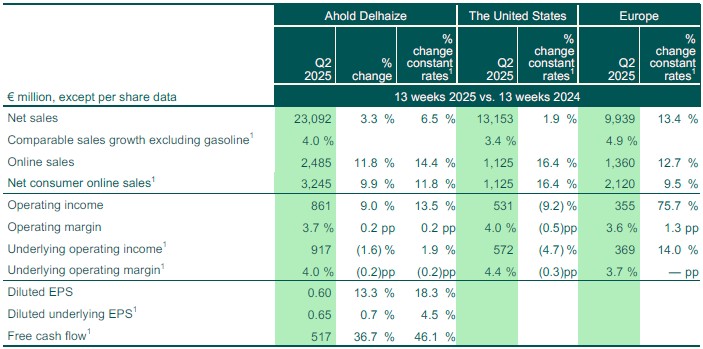
1. Comparable sales growth excluding gasoline, net consumer online sales, underlying operating income and related margin, diluted underlying EPS, free cash flow, and the percentage changes at constant rates are alternative performance measures that are used throughout this report. For a description of alternative performance measures and a reconciliation between percentage changes and percentage changes at constant rates, see Note 13 in the full Interim Report.
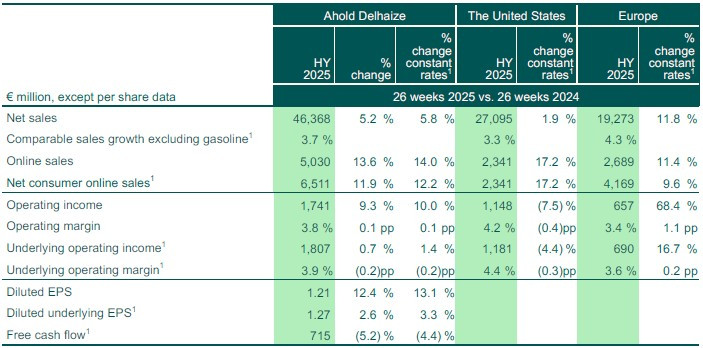
1. Comparable sales growth excluding gasoline, net consumer online sales, underlying operating income and related margin, diluted underlying EPS, free cash flow, and the percentage changes at constant rates are alternative performance measures that are used throughout this report. For a description of alternative performance measures and a reconciliation between percentage changes and percentage changes at constant rates, see Note 13 in the full Interim Report.
Comments from Frans Muller, President and CEO of Ahold Delhaize
"I am pleased to report solid second quarter performance, with strong sales growth supported by positive volumes in both regions. In an environment where customers prioritize value and convenience, our Growing Together strategy stands out as a key strength. Our brands’ unwavering commitment to delivering exceptional customer value has enabled us to maintain or improve our market positions and continue to drive momentum in growth. At the same time, through strong operational execution by our teams and associates, we delivered a healthy and stable underlying operating margin of 4.0% and IFRS operating income of €861 million.
“During the quarter, group net sales increased 6.5% at constant rates (3.3% at actual rates) and comparable sales growth excluding gasoline was 4.0%. Net group sales were positively impacted by 3.4 percentage points from the Profi acquisition and negatively impacted by 1.2 percentage points from the closure of Stop & Shop stores and the cessation of tobacco sales in the Netherlands and Belgium.
“In the U.S., net sales increased 1.9% at constant rates (decreased 3.1% at actual rates), while comparable sales growth excluding gasoline increased 3.4%, positively impacted by 0.9 percentage points from calendar shifts. All of our U.S. brands have now launched price investments, while strategically leveraging the strength of our own-brand portfolios. So far this year, we have introduced 300 new own-brand products and seen sales growth outpace the rest of the store in both dollars and units. It has also been one year since we announced decisive and deliberate actions to ensure a stable and thriving future for Stop & Shop. We are encouraged by customers’ response to the initiatives we have implemented thus far. Where we have made investments, we are attracting new customers and seeing increasing volumes and an improving net promoter score.
“In Europe, our growth trajectory has been remarkable. Net sales increased 13.4% at constant rates (13.3% at actual rates), including the impact of Profi, while comparable sales excluding gasoline increased 4.9%, despite the net negative impact from tobacco and calendar shifts of 0.9 percentage points. This extends a period of impressive performance, as our teams drive innovation and adapt swiftly to evolving consumer trends. Bol grew 12.5%. We are making great progress on two key strategies at this brand: international partner expansion, through which we have already onboarded around 300 high-quality international partners so far this year, and the expansion of our advertising services, which have grown over 30% during the quarter. We are also making good progress with the integration of Profi, which has significantly contributed to our revenue growth in Europe and strengthened our market position within Romania.
“During the first half of the year, we already achieved a key milestone by reaching e-commerce profitability on a fully allocated basis. This underscores the strength and scalability of our omnichannel model, which is an important long-term driver of market share growth. Our improved online profitability is the result of several key factors, including our orientation towards less asset-intense same-day delivery models, increasing fulfilment capacity, automating operations and leveraging retail media propositions. It is particularly encouraging to see that, more and more, customers are finding value in the convenience and flexibility of our brands' omnichannel offerings. During the quarter, online sales grew 14.4%, marking the fifth consecutive quarter of double-digit growth. We also expanded our e-commerce market share in both regions. This quarter, we completed the rollout of PRISM, our proprietary e-commerce platform, at Food Lion, with plans to extend it to Hannaford in the second half of the year. Delhaize has doubled its ecommerce capacity in Belgium with a new distribution center in Vorst. At Albert Heijn, our proposition for B2B customers has paid off, with sales and orders increasing by over 10%.
“Our success is driven by the dedication of more than 390,000 associates who serve over 72 million customers weekly. Their hard work and commitment are at the core of our brands' operations and community engagement. To support associates, our brands are investing in technology to simplify their ways of working and make their jobs easier. Most of our European brands have introduced AI-driven assistants, including MaxiGPT in Serbia, LionGPT at Delhaize, Albot at Albert and De Assistent at Albert Heijn. These AI solutions ensure associates have easy access to the right information so they can help customers better and faster. Albert is rolling out AI technology that helps cashiers quickly identify unpackaged items, shortening the checkout process, improving accuracy, and making the work easier. In the U.S., we have rolled out updates to our Spectrum proprietary technology to simplify and modernize order management for online fulfilment.
"In the first half of 2025, we made good progress on our performance in the areas of healthy food sales, CO₂e emissions and food waste. This year, our brands are putting a key focus on expanding the offering of healthy and sustainable food options for our customer base. Through innovation and creative solutions, I am convinced we can achieve a lot. A good example of this in the most recent quarter was Albert Heijn's introduction of 15 new products that combine both animal-derived and plant-based ingredients. This mix provides a familiar taste and texture, along with improved nutritional values (such as lower saturated fat content) and lower CO₂e emissions. To reduce food waste, Albert has been actively promoting its initiative to upcycle unsold products, for example, transforming ripe bananas into banana bread.
"Our focus on striking the right balance between investing in growth and creating opportunities to drive operational excellence continue to fuel the positive outlook for our company. With our strong culture – known for its agility, consistency, ability to drive transformative change and commitment to sustainability – I am confident we are well prepared to navigate the complexities of the current business environment and position the company to drive brand strength and market share growth in the coming periods."
Q2 Financial highlights
Group highlights
Ahold Delhaize net sales were €23.1 billion, an increase of 6.5% at constant exchange rates and up 3.3% at actual exchange rates. Our net sales growth was driven by the Profi acquisition, comparable sales growth excluding gasoline of 4.0%, and store openings, partially offset by the closure of Stop & Shop stores and lower gasoline sales. The Company's Q2 comparable sales excluding gasoline were positively impacted by 0.8 percentage points, due to calendar shifts, and negatively impacted by 0.6 percentage points from the cessation of tobacco sales at supermarkets in the Netherlands and Belgium.
In Q2, Ahold Delhaize online sales increased 14.4% at constant exchange rates. This was driven by double-digit growth in online grocery in both regions and strong performance at bol.
Ahold Delhaize underlying operating margin was 4.0%, a decrease of 0.2 percentage points at constant exchange rates. Strong performance in Europe was offset by the impact of the first-time consolidation of Profi and price investments in the U.S.
In Q2, Ahold Delhaize IFRS operating income was €861 million, representing an IFRS operating margin of 3.7%. Diluted EPS was €0.60 and diluted underlying EPS was €0.65, up 0.7% at actual currency rates compared to last year's results.
In the quarter, Ahold Delhaize purchased 9.7 million of its own shares for €337 million, bringing the total amount to €442 million in the first half of the year. The 2025 interim dividend is €0.51, compared to €0.50 in 2024, and is in line with the Group's interim dividend policy.
U.S. highlights
U.S. net sales were €13.2 billion, an increase of 1.9% at constant exchange rates and down 3.1% at actual exchange rates. Comparable sales excluding gasoline in the U.S. increased 3.4%, driven by continued growth in online and pharmacy sales. Calendar shifts had a positive impact of approximately 0.9 percentage points. Net sales were negatively impacted by 1.1 percentage points from the closure of Stop & Shop stores and lower gasoline sales.
In Q2, online sales increased 16.4% in constant currency, led by strong growth at Food Lion.
Underlying operating margin in the U.S. was 4.4%, down 0.3 percentage points due to price investments and the dilutive impact from growth in online and pharmacy sales.
U.S. IFRS operating income was €531 million, representing an IFRS operating margin of 4.0%. IFRS results were €42 million lower than underlying results due, in part, to store impairments.
Europe highlights
European net sales were €9.9 billion, an increase of 13.4% at constant exchange rates and 13.3% at actual exchange rates. The higher net sales were partly due to the Profi acquisition, an increase in comparable sales of 4.9%, and store openings, partially offset by the impact from the conversion of stores in Belgium to affiliates. Europe's comparable sales excluding gasoline had a positive impact of 0.7 percentage points from calendar shifts and a negative impact of 1.6 percentage points resulting from the cessation of tobacco sales at supermarkets in the Netherlands and Belgium.
In Q2, online sales increased 12.7%, driven by double-digit growth at bol and Albert Heijn.
Underlying operating margin in Europe was 3.7%, in line with the prior year. Strong performance in the Benelux was offset by the impact of the first-time consolidation of Profi. Europe's Q2 IFRS operating income was €355 million, representing an IFRS operating margin of 3.6%.
Outlook
Following the first half of the year, Ahold Delhaize reiterates its 2025 outlook. Underlying operating margin is expected to be around 4%; free cash flow is expected to be at least €2.2 billion; and gross capital expenditures are planned at around €2.7 billion. Diluted underlying EPS is expected to grow at a mid- to high-single-digit rate, based on an average euro/U.S. dollar exchange rate for the full year of 1.10. Diluted underlying EPS results at actual exchange rates are subject to dollar volatility.
The following are changes in the business that will impact comparable performance for 2025 and that have
been incorporated into our Outlook:
- The acquisition of Profi closed on January 3, 2025, and is expected to add around €3 billion in net sales.
- The closure of underperforming Stop & Shop stores was completed in 2024. The estimated net impact to 2025 reported net sales from these closures is between $550 and $575 million.
- The cessation of tobacco sales will impact Albert Heijn's net sales at franchised stores for the first half of the year. In addition, Delhaize and Albert Heijn stores in Belgium ended tobacco sales as of April 1, 2025, due to regulation changes. This will have around a 1.0 percentage-point impact on reported and comparable store sales in Europe in 2025.

1. Excludes M&A.
2. Calculated as a percentage of underlying income from continuing operations.
3. Based on an average euro/U.S. dollar exchange rate for the full year of 1.10.
4. Management remains committed to the company's share buyback and dividend programs while continuously assessing macroeconomic, geopolitical, and legislative factors as part of its decision-making process. In addition, the programs may be adjusted in response to corporate activities, including significant mergers and acquisitions.
downloads

webcast
This communication contains information that qualifies as inside information within the meaning of Article 7(1) of the EU Market Abuse Regulation.
This communication includes forward-looking statements. All statements other than statements of historical facts may be forwardlooking statements. Forward-looking statements can be identified by certain words, such as “anticipate,” “intend,” “plan,” “goal,” “seek,” “believe,” “project,” “estimate,” “expect,” “strategy,” “future,” “likely,” “may,” “should,” “will” and similar references to future periods.
Forward-looking statements are subject to risks, uncertainties and other factors that are difficult to predict and that may cause the actual results of Koninklijke Ahold Delhaize N.V. (the “Company”) to differ materially from future results expressed or implied by such forward-looking statements. Therefore, you should not place undue reliance on any of these forward-looking statements. Factors that might cause or contribute to such a material difference include, but are not limited to, risks relating to the Company’s inability to successfully implement its strategy, manage the growth of its business or realize the anticipated benefits of acquisitions; risks relating to competition and pressure on profit margins in the food retail industry; the impact of economic conditions, including high levels of inflation, on consumer spending; changes in consumer expectations and preferences; turbulence in the global capital markets; political developments, natural disasters and pandemics; wars and geopolitical conflicts; climate change; energy supply issues; raw material scarcity and human rights developments in the supply chain; disruption of operations and other factors negatively affecting the Company’s suppliers; the unsuccessful operation of the Company’s franchised and affiliated stores; changes in supplier terms and the inability to pass on cost increases to prices; risks related to environmental, social and governance matters (including performance) and sustainable retailing; risks related to data management and data privacy; food safety issues resulting in product liability claims and adverse publicity; environmental liabilities associated with the properties that the Company owns or leases; competitive labor markets, changes in labor conditions and labor disruptions; increases in costs associated with the Company’s defined benefit pension plans; ransomware and other cybersecurity issues relating to the failure or breach of security of IT systems; the Company’s inability to successfully complete divestitures and the effect of contingent liabilities arising from completed divestitures; antitrust and similar legislation; unexpected outcomes in the Company’s legal proceedings; additional expenses or capital expenditures associated with compliance with federal, regional, state and local laws and regulations; unexpected outcomes with respect to tax audits; the impact of the Company’s outstanding financial debt; the Company’s ability to generate positive cash flows; fluctuation in interest rates; the change in reference interest rate; the impact of downgrades of the Company’s credit ratings and the associated increase in the Company’s cost of borrowing; exchange rate fluctuations; inherent limitations in the Company’s control systems; changes in accounting standards; inability to obtain effective levels of insurance coverage; adverse results arising from the Company’s claims against its self insurance program; the Company’s inability to locate appropriate real estate or enter into real estate leases on commercially acceptable terms; and other factors discussed in the Company’s public filings and other disclosures.
Forward-looking statements reflect the current views of the Company’s management and assumptions based on information currently available to the Company’s management. Forward-looking statements speak only as of the date they are made, and the Company does not assume any obligation to update such statements, except as required by law.