

Ahold Delhaize reports resilient Q2 2026 results and reiterates guidance for the year
- Anchored by the strong execution of our Growing Together strategy, we delivered a resilient performance in the second quarter. Through disciplined investments in our customer value propositions, innovation and growth, combined with strong cost management, we strengthened our market positions and gained share across our major markets and brands in an uncertain macroeconomic environment.
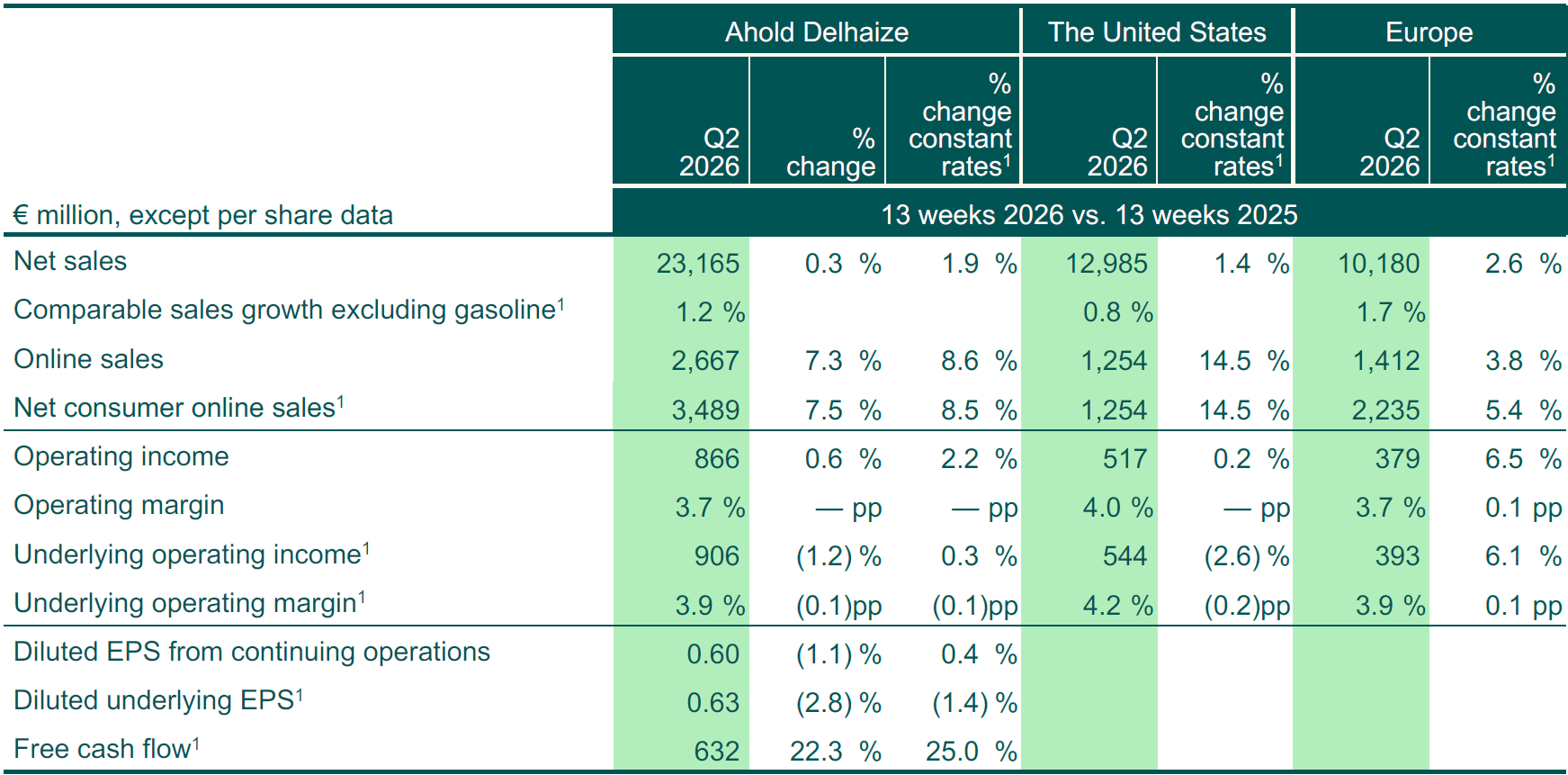
- Q2 net sales were €23.2 billion, up 1.9% at constant exchange rates and up 0.3% at actual exchange rates.
- Q2 comparable sales excluding gasoline increased 0.8% in the U.S. They were negatively impacted by 0.1 percentage points due to calendar shifts and 0.7 percentage points due to pharmacy pricing related to the Inflation Reduction Act. Deflation in egg prices and lower Supplementary Nutrition Assistance Program (SNAP) benefits from program changes had a negative impact of 0.9 percentage points.
- Q2 comparable sales excluding gasoline increased 1.7% in Europe. Calendar shifts had a negative impact of 0.1 percentage points.
- Ahold Delhaize's online sales increased 8.6% in Q2 at constant exchange rates and 7.3% at actual exchange rates. This was driven by strong growth of 14.5% at constant exchange rates in the U.S., where customers continue to appreciate the convenience, assortments and personalization offered by our online shopping experiences, supported by our strong omnichannel model.
- Q2 underlying operating margin was 3.9%, a decrease of 0.1 percentage points at constant exchange rates. Improvements in Europe were more than offset by a modest decline in the U.S.
- Q2 diluted underlying earnings per share (EPS) was €0.63, a decrease of 1.4% compared to the prior year at constant exchange rates.
- Q2 IFRS operating income was €866 million and IFRS-diluted EPS from continuing operations was €0.60.
- The 2026 interim dividend is €0.51 (2025: €0.51), based on the Group's dividend policy.
- The Company reiterates its 2026 outlook (53 weeks): underlying operating margin of around 4%; mid- to high-single-digit diluted underlying EPS growth at constant exchange rates; free cash flow of at least €2.3 billion; and gross cash capital expenditures of around €2.7 billion.
Zaandam, the Netherlands, August 5, 2026 – Ahold Delhaize, an international food retail group and a leader in both supermarkets and e-commerce, reports second quarter results today.
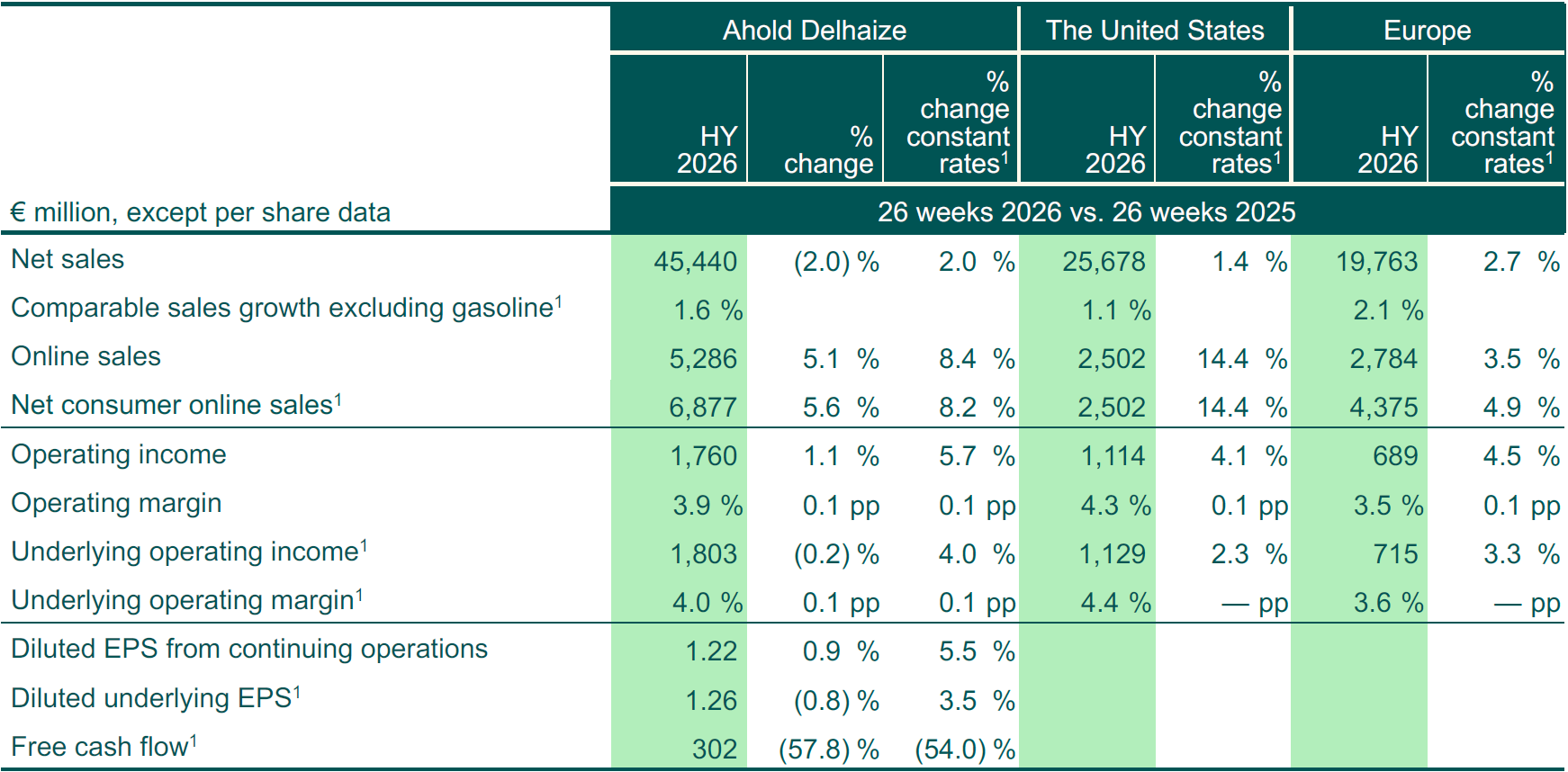
Summary of key financial data
1. Comparable sales growth excluding gasoline, net consumer online sales, underlying operating income and related margin, diluted underlying EPS, free cash flow, and percentage change at constant rates are alternative performance measures that are used throughout this report. For a description of alternative performance measures and a reconciliation between percentage change and percentage change at constant rates, see Note 12 in the full interim report.
1. Comparable sales growth excluding gasoline, net consumer online sales, underlying operating income and related margin, diluted underlying EPS, free cash flow, and percentage change at constant rates are alternative performance measures that are used throughout this report. For a description of alternative performance measures and a reconciliation between percentage change and percentage change at constant rates, see Note 12 in the full interim report.
Comments from Frans Muller, President and CEO of Ahold Delhaize
“In the second quarter, we delivered another solid performance, demonstrating the resilience of our Growing Together strategy and the strength of our local brands in a challenging market. Every week, millions of loyalty interactions help our brands understand customers in real time. Combined with data and AI, these insights have allowed our brands to personalize experiences, improve decisions and strengthen their connection with the communities they serve.
“This summer marks the 10th anniversary of the merger between Ahold and Delhaize Group – a milestone that reminds us how much we have accomplished. What started as a belief that strong local brands become even stronger through international scale has become a proven model for profitable growth and market share expansion. Together, our brands have successfully navigated through unprecedented change, continued to earn customers' trust and consistently created value for all our stakeholders. As we enter into our next decade, we do so with confidence, clear priorities and significant opportunities ahead.
“Q2 net sales increased 1.9% at constant rates (0.3% at actual rates), with comparable sales growth excluding gasoline of 1.2%. During the quarter, we invested in customer value, strengthened our positions in key markets and accelerated innovation, while maintaining strong cost discipline. These actions are particularly important in an environment where households remain value conscious and customers continue to make careful choices about where they shop. This balanced approach enabled us to navigate macroeconomic and geopolitical pressures, absorb the majority of costs from higher energy prices and deliver a healthy underlying operating margin of 3.9%. On an IFRS basis, we delivered operating income of €866 million. Most importantly, customers responded positively to our efforts, supporting resilient volumes in markets under pressure and driving market share gains across most of our major brands (U.S. market share based on latest available Nielsen Data – Q1 2026).
“Own brands are a key competitive advantage across our portfolio, helping customers manage their budgets without compromising on quality while deepening loyalty to our brands. During the quarter, we grew own-brand food penetration by 0.7 percentage points, marking an important milestone as we now surpass 40% penetration at the Group level. Hannaford has priced more than 3,500 key value items in its own-brand assortment at parity with leading competitors. Albert Heijn lowered prices on more than 500 items to further strengthen its value perception. And in Serbia, Maxi now offers hundreds of high-quality affordable products under its new 'Price Favorites' label. Delhaize expanded its loyalty program for families through which – for one euro per month – families can get additional volume discounts on a wide range of healthy and plant-based own-brand products.
“In the U.S., we strengthened our competitive position in an environment where value and convenience remain top priorities for customers. Net sales increased 1.4% at constant rates (decreased 1.3% at actual rates), while comparable sales growth excluding gasoline was 0.8%. A key highlight was our strong online performance, with online sales growing 14.5% at constant rates (11.5% at actual rates). This underscores the value of our omnichannel model in expanding reach, enhancing convenience and attracting new customers. At the same time, we made targeted price investments, including lowering everyday prices on thousands of items across Stop & Shop's 137 stores in New York and New Jersey. All Stop & Shop locations now have price investments in place. Across our U.S. business, these actions are supporting market share gains and net promoter score improvements, despite lower topline growth from a challenging backdrop that included lower egg prices, pharmacy pricing changes related to the Inflation Reduction Act and reduced SNAP benefits.
“Our business in Europe delivered another solid quarter, with broad-based strong performance across the region. Net sales increased 2.6% at constant rates (2.4% at actual rates), while comparable sales excluding gasoline increased 1.7%. Our brands in Belgium are building on encouragingmomentum, supported by excellent operational discipline and the success of our localization and franchising strategy. Both Delhaize and Albert Heijn continue to grow share in the Belgian market, reflecting the strength of our complementary propositions. Albert, in the Czech Republic, delivered its 38thconsecutive quarter of comparable sales growth (excluding calendar shifts), demonstrating the strength of consistent execution and a strong customer proposition in a deflationary environment.
"Technology, data and AI make our local brands stronger and the combination of our portfolio even more powerful. We continue to invest in our data and technology foundation, looking at AI through three lenses: re-imagining business domains, optimizing existing processes and systems, and democratizing AI tools for all associates. At Albert Heijn, we are re-imagining Merchandising for a future built on AI-driven, agentic commerce. In the U.S., we are modernizing our retail technology backbone to create the foundation for the next generation of AI-enabled capabilities. And we offer top AI models to our associates in a secure platform that protects company data. Beyond this, we are strengthening digital engagement through a range of initiatives designed to create more relevant, personalized experiences for customers, including our global retail media platform Edge, new capabilities on our U.S. loyalty platform, and enhancements to the My Albert Heijn app.
"Looking ahead, we expect the operating environment to remain challenging. But challenging markets also provide the clearest measure of competitive strength. They test whether customers continue to choose your brands, whether your value proposition resonates and whether you are executing consistently. Our half year performance gives us confidence that we are focused on the right things. We will continue to earn customers' trust through outstanding value, quality and convenience, making life simpler for customers and associates through technology and innovation, and investing with discipline to strengthen our brands and build the capabilities that will drive our next decade of growth. Supported by our strong cash generation and resilient business model, we are pleased to reconfirm our full-year 2026 guidance."
Q2 Financial highlights
Group highlights
Ahold Delhaize's net sales were €23.2 billion, an increase of 1.9% at constant exchange rates and up 0.3% at actual exchange rates. Our net sales growth was driven by comparable sales growth excluding gasoline of 1.2%, higher gasoline sales, the Delfood acquisition and net store openings. The Company's Q2 comparable sales excluding gasoline were negatively impacted by 0.1 percentage points due to calendar shifts and by 0.4 percentage points due to a reduction in pharmacy prices related to the Inflation Reduction Act. Egg price deflation and lower SNAP benefits from program changes in the U.S. had a negative impact of 0.5 percentage points.
In Q2, Ahold Delhaize's online sales increased 8.6% at constant exchange rates. This was driven by 14.5% growth in the U.S.
Ahold Delhaize's underlying operating margin was 3.9%, a decrease of 0.1 percentage points at constant exchange rates. Improvements in Europe were more than offset by a modest decline in the U.S.
Ahold Delhaize's IFRS operating income was €866 million, representing an IFRS operating margin of 3.7%.
Diluted EPS from continuing operations was €0.60 and diluted underlying EPS was €0.63, down 1.4% at constant exchange rates compared to last year's results.
In the quarter, Ahold Delhaize purchased 9.0 million of its own shares for €340 million, bringing the total amount to €564 million in the first half of the year. The 2026 interim dividend is €0.51, compared to €0.51 in 2025, and is in line with the Group's dividend policy.
U.S. highlights
U.S. net sales were €13.0 billion, an increase of 1.4% at constant exchange rates and down 1.3% at actual exchange rates. Net sales growth was driven by 0.8% comparable sales growth excluding gasoline and higher gasoline sales. Comparable sales growth excluding gasoline was driven by continued growth in online sales. Calendar shifts had a negative impact of 0.1 percentage points and pharmacy prices related to the Inflation Reduction Act had a negative impact of 0.7 percentage points. Egg deflation and lower SNAP benefits from program changes had a negative impact of 0.9 percentage points.
In Q2, online sales increased 14.5% at constant exchange rates, marking the ninth consecutive quarter of double-digit growth. Food Lion led brand performance with over 20% growth.
Underlying operating margin in the U.S. was 4.2%, down 0.2 percentage points as a result of price investments, higher utility costs and the absorption of indirect costs from higher energy prices, partially offset by a favorable mix in pharmacy.
Q2 IFRS operating income was €517 million, representing an IFRS operating margin of 4.0%.
Europe highlights
European net sales were €10.2 billion, an increase of 2.6% at constant exchange rates and 2.4% at actual exchange rates. Higher net sales were due to comparable sales growth excluding gasoline of 1.7%, the Delfood acquisition and net store openings. Calendar shifts had a negative impact of 0.1 percentage points.
In Q2, online sales increased 3.8%, keeping pace with the prior quarter as we maintained our strong market positions in a competitive and challenging consumer environment. Performance at bol was impacted by the cycling of a strong prior year and ongoing consumer pressures contributing to downtrading within bol's assortment. At the same time, the platform continues to be highly innovative; one of bol's (indirect) subsidiaries, bol Payment Services B.V., has recently obtained a license as a payment provider from De Nederlandsche Bank (DNB) that will enable bol to sustain its ecosystem.
Underlying operating margin in Europe was 3.9%, up 0.1 percentage points. Lower turnover tax rate (IMCA), the realization of synergies in Romania and labor productivity improvements were partially offset by lower performance in Serbia following the recent governmental decree on grocery industry pricing and the absorption of indirect costs from higher energy prices.
Europe's Q2 IFRS operating income was €379 million, representing an IFRS operating margin of 3.7%.
Outlook
Following the second quarter performance, we reiterate our 2026 outlook, which we announced when we published our Q4 2025 results. Underlying operating margin is expected to be around 4%. Diluted underlying EPS is expected to grow at a mid- to high-single-digit rate at constant exchange rates. Free cash flow is expected to be at least €2.3 billion. Gross cash capital expenditures are planned at around €2.7 billion.
The following are changes in the business that will impact comparable performance for 2026 and that have been incorporated into our Outlook:
- The Inflation Reduction Act is impacting U.S. pharmacy sales. It is expected to have an approximate $450 million negative impact on reported and comparable store sales in the U.S. There is no material impact on underlying operating income.
- The acquisition of Delfood closed on February 2, 2026, and is expected to add over €200 million in net sales to our Europe segment.
- 2026 will have a 53rd week, which is expected to have a positive impact of 1.5-2% on net sales and a positive impact of around 2-3% on underlying income from continuing operations. This does not significantly impact underlying operating margin.

1. Excludes M&A.
2. 2026 is a 53-week calendar year.
3. Management remains committed to the Company's share buyback and dividend programs while continuously assessing macroeconomic, geopolitical and legislative factors as part of its decision-making process. In addition, the programs may be adjusted in response to corporate activities, including significant mergers and acquisitions.
4. Our dividend policy is to target a dividend payout ratio range of 40-50%.
downloads

webcast
This communication contains information that qualifies as inside information within the meaning of Article 7(1) of the EU Market Abuse Regulation.
This communication includes forward-looking statements. All statements other than statements of historical facts may be forward-looking statements. Forward-looking statements can be identified by certain words, such as “anticipate,” “intend,” “plan,” “goal,” “seek,” “believe,” “project,” “estimate,” “expect,” “strategy,” “future,” “likely,” “may,” “should,” “will” and similar references to future periods.
Forward-looking statements are subject to risks, uncertainties and other factors that are difficult to predict and that may cause the actual results of Koninklijke Ahold Delhaize N.V. (the “Company”) to differ materially from future results expressed or implied by such forward-looking statements. Therefore, you should not place undue reliance on any of these forward-looking statements. Factors that might cause or contribute to such a material difference include, but are not limited to, risks relating to the Company’s inability to successfully implement its strategy, manage the growth of its business or realize the anticipated benefits of acquisitions; risks relating to competition and pressure on profit margins in the food retail industry; the impact of economic conditions, including high levels of inflation, on consumer spending; changes in consumer expectations and preferences; turbulence in the global capital markets; political developments, natural disasters and pandemics; wars and geopolitical conflicts; climate change; energy supply issues; raw material scarcity and human rights developments in the supply chain; disruption of operations and other factors negatively affecting the Company’s suppliers; the unsuccessful operation of the Company’s franchised and affiliated stores; changes in supplier terms and the inability to pass on cost increases to prices; risks related to environmental, social and governance matters (including performance) and sustainable retailing; risks related to data management and data privacy; food safety issues resulting in product liability claims and adverse publicity; environmental liabilities associated with the properties that the Company owns or leases; competitive labor markets, changes in labor conditions and labor disruptions; increases in costs associated with the Company’s defined benefit pension plans; ransomware and other cybersecurity issues relating to the failure or breach of security of IT systems; disruption from developments in artificial intelligence or inability to realize related benefits; the impact of adverse publicity or operational disruption related to activism or negative media coverage; the Company’s inability to successfully complete divestitures and the effect of contingent liabilities arising from completed divestitures; antitrust and similar legislation; unexpected outcomes in the Company’s legal proceedings; additional expenses or capital expenditures associated with compliance with federal, regional, state and local laws and regulations; unexpected outcomes with respect to tax audits; the impact of the Company’s outstanding financial debt; the Company’s ability to generate positive cash flows; fluctuation in interest rates; the change in reference interest rate; the impact of downgrades of the Company’s credit ratings and the associated increase in the Company’s cost of borrowing; exchange rate fluctuations; inherent limitations in the Company’s control systems; changes in accounting standards; inability to obtain effective levels of insurance coverage; adverse results arising from the Company’s claims against its self-insurance program; the Company’s inability to locate appropriate real estate or enter into real estate leases on commercially acceptable terms; and other factors discussed in the Company’s public filings and other disclosures.
Forward-looking statements reflect the current views of the Company’s management and assumptions based on information currently available to the Company’s management. Forward-looking statements speak only as of the date they are made, and the Company does not assume any obligation to update such statements, except as required by law.